Sustainability

What is green building?

A few weeks ago, EFE Verde contacted us to talk about green building, so today we bring you an article on what green building is.
Publicado el 08 April 2024
que es la bioconstruccion

A few weeks ago, we were contacted by EFE Verde to discuss what green building is and how it is applied in contemporary architecture.

EFE Verde is the global environmental news platform of the EFE Agency, specializing in current affairs regarding the environment, renewable energy, biodiversity, circular economy and, in general, sustainable development.

It was an in-depth interview in which we addressed the current viability of green building from the perspective of an architectural team that applies it practically in its projects, combining ecological and health criteria.

In addition to debunking certain myths about the economic viability of building a healthy and efficient home, we consider it essential to highlight that green building requires a high level of professional rigor. Every decision must be carefully evaluated, analyzing the potential increase in costs in relation to the benefits obtained in terms of energy efficiency, well-being, and health for its occupants.

WHAT IS green building?


In general terms, green building consists of applying common-sense criteria to construction, always seeking harmony between people and the environment. It involves designing and building homes that minimize their environmental impact, optimize energy efficiency, and provide a healthy indoor environment for their occupants.

Today, we have the knowledge and technology necessary to build nearly zero-energy homes, capable of generating their own energy and maintaining optimal indoor conditions without the need for high energy consumption. At our studio, this is the model we strive to implement in every project.

Number of homes built under green building criteria


If we speak of green building in the strictest sense—that is, zero-consumption homes built solely with natural materials—the number remains small, both nationally and internationally. This is largely because an execution completely faithful to these principles usually implies a higher cost than constructions using insulation or elements derived from petroleum. For many clients, committing 100% to green building and natural insulation means sacrificing square footage or adjusting other budget items, which is not always viable.

In our approach, we propose a balance: each family defines its priorities, deciding whether to invest more in surface area, energy efficiency, or natural materials. It is not always possible to maximize everything, but it is possible to reach a middle ground that combines sustainability, comfort, and economic viability.

How has green building evolved?


Before discussing increases or trends, it is worth clarifying that, rather than differentiating between ecological housing and conventional housing, we should speak of well-built homes and poorly built homes. A well-built home is one that uses natural, non-polluting materials and that, thanks to its design, harnesses and stores solar heat without needing to resort to energy from fossil fuels to maintain a comfortable indoor environment. In essence, this is the true meaning of what we know today as green building.

If we look at history, the period of greatest splendor for well-built homes occurred before the Industrial Revolution. For centuries, constructions adapted to the environment, utilized local resources, and functioned passively to maintain comfort. However, with the arrival of coal and oil, construction began to focus on lowering immediate costs at the expense of increasing energy dependence through intensive heating systems and the use of plastic insulation.

Today we know that this strategy, while cheaper in the short term, is much more costly in the long run. A poorly insulated home generates a “second mortgage” in the form of continuous energy expenditure, in addition to creating dry indoor environments that affect our health by reducing our natural defenses. Added to this is the environmental impact of using fossil fuels and the ecological footprint derived from non-sustainable materials such as petroleum-based insulation.

The challenge of modern green building is to recover the logic of traditional constructions, adapting it to today’s technology and knowledge, so that one day it can become the norm rather than the exception.

What is the cost difference between a conventional home and an ecological one?


The difference depends on two main factors: the materials used and the energy efficiency of the design.

If we talk about the use of natural materials versus conventional ones, the cost per square meter is usually higher. For example, cork insulation is more expensive than expanded polystyrene. This occurs partly because current regulations do not penalize the additional CO₂ emissions derived from the manufacture of petroleum-based materials, which artificially lowers their price. However, installing cork insulation in an exposed manner, as in the House in Serra d’Ordal, allows us to avoid finishing layers that offset this cost.

On the other hand, if we focus on energy efficiency, it is possible to build a very efficient home—and therefore one with low consumption—using non-natural materials. In these cases, although the initial cost may be similar to or slightly higher than that of a conventional home, the savings in heating and cooling over its useful life can be very significant. In fact, many of these houses are labeled as “ecological” precisely because, thanks to their design, they practically eliminate energy expenditure on climate control.

How and when did your interest in green building arise?


At Slow Studio, we understand green building as something that goes far beyond a construction technique: it is a way of understanding life. Designing and building healthy and efficient homes is aligned with the way we live, eat, travel, or educate our children. Ecological awareness is a commitment that, once acquired, permeates every personal and professional decision and guides us in all our projects.

Our studio, based in Barcelona, specializes in passive and bioclimatic architecture, integrating energy efficiency and natural materials to minimize environmental impact and prioritize people’s health and well-being. In addition to developing single-family housing projects, we promote Slow Living, a line of work focused on promoting sustainable and affordable housing within the collective housing sector. These developments are designed with bioclimatic criteria, decarbonized materials, and passive strategies, bringing the quality and comfort of a passive house to a wider audience.

The commitment to green building is complemented by a strong effort in outreach and climate activism: we participate in conferences, collaborate with universities, and share knowledge on social media to bring concepts such as bioclimatism, energy efficiency, and health in housing closer to professionals and users.

which material is most optimal for green building?


The choice of material depends on both the location and the intended use of the home. Building a weekend house, which must heat up quickly when its occupants arrive, is not the same as building a home for continuous use by a family, where materials capable of accumulating heat gradually and maintaining a stable indoor environment are needed. Therefore, in green building, there is no “single” or universally optimal material; every decision is adapted to local climatic conditions, the desired thermal behavior, and the functionality of the home.

In the case of primary residences, we are great supporters of earth construction, a material traditionally very present in our country that allows for the accumulation of thermal inertia and maintains stable comfort throughout the day.

Why do many people hesitate to build an ecological home?


Currently, this statement is no longer entirely true. Today, most people considering building their own home want it to be ecological or, at least, efficient. The real factor that holds many people back is the initial cost. However, when it is understood that a slightly higher investment pays for itself in about five years thanks to energy savings, the decision becomes much more attractive: everyone wants a zero-consumption house.

Another important aspect is the choice of materials. An efficient passive house can be built using wood fiber insulation or extruded polystyrene derived from petroleum; both achieve similar results in thermal efficiency, but the latter has a much larger ecological footprint and can compromise the breathability of the walls, favoring the appearance of damp or mold if not properly executed.

Today there are many companies that sell “ecological houses,” but when looking closely at the materials they use, they often do not meet truly sustainable criteria.

How do you evaluate the materials most commonly used in green building, such as adobe, straw, wood, stone, bamboo, or brick?


Regarding the materials most commonly used in green building, their choice depends on the project’s use, location, and the balance between surface area, energy efficiency, and natural materials, especially considering the clients’ budgets.

Wood, although very fashionable, has limitations depending on its origin. In Northern European countries, with forests of large, straight trees, its availability facilitates its use; in Spain, local wood tends to come from small, twisted pines, so much of the wood used comes from Northern Europe, which may not be ecological due to the CO₂ emissions from transport. Furthermore, wood does not accumulate heat, so in a Mediterranean climate, it needs to be complemented with materials that do retain heat to maintain comfort in winter and coolness in summer. Therefore, it is suitable when combined with brick or for weekend homes.

Stone and adobe, including rammed earth walls, have excellent thermal properties, accumulating solar heat in winter and maintaining coolness in summer. Their installation requires specialized and artisanal labor, which increases the project cost, although they offer a very efficient and healthy result. Straw, as a non-structural insulator, requires specialized knowledge and protection from moisture; otherwise, it can rot, so there are more effective alternatives, such as cork. Natural bricks, such as thermo-clay, are another very interesting option: they are natural materials whose installation is no more expensive than other non-ecological materials and they allow for good thermal performance. Finally, bamboo, although it has potential in certain contexts, has limited use in our country and does not always justify the investment compared to other materials better adapted to the climate and local availability.

In short, there is no “perfect material”: each must be evaluated according to its function, climatic conditions, thermal efficiency, and the sustainability of its origin. Green building consists of balancing these factors to achieve healthy, efficient, and environmentally friendly homes.

 

What effects does a conventional home have on the environment and the health of its inhabitants?


In relation to the environment, we should evaluate each case, but generally, we speak of the ecological footprint: how much CO₂ we have emitted with our construction and how much we will continue to emit throughout its useful life.

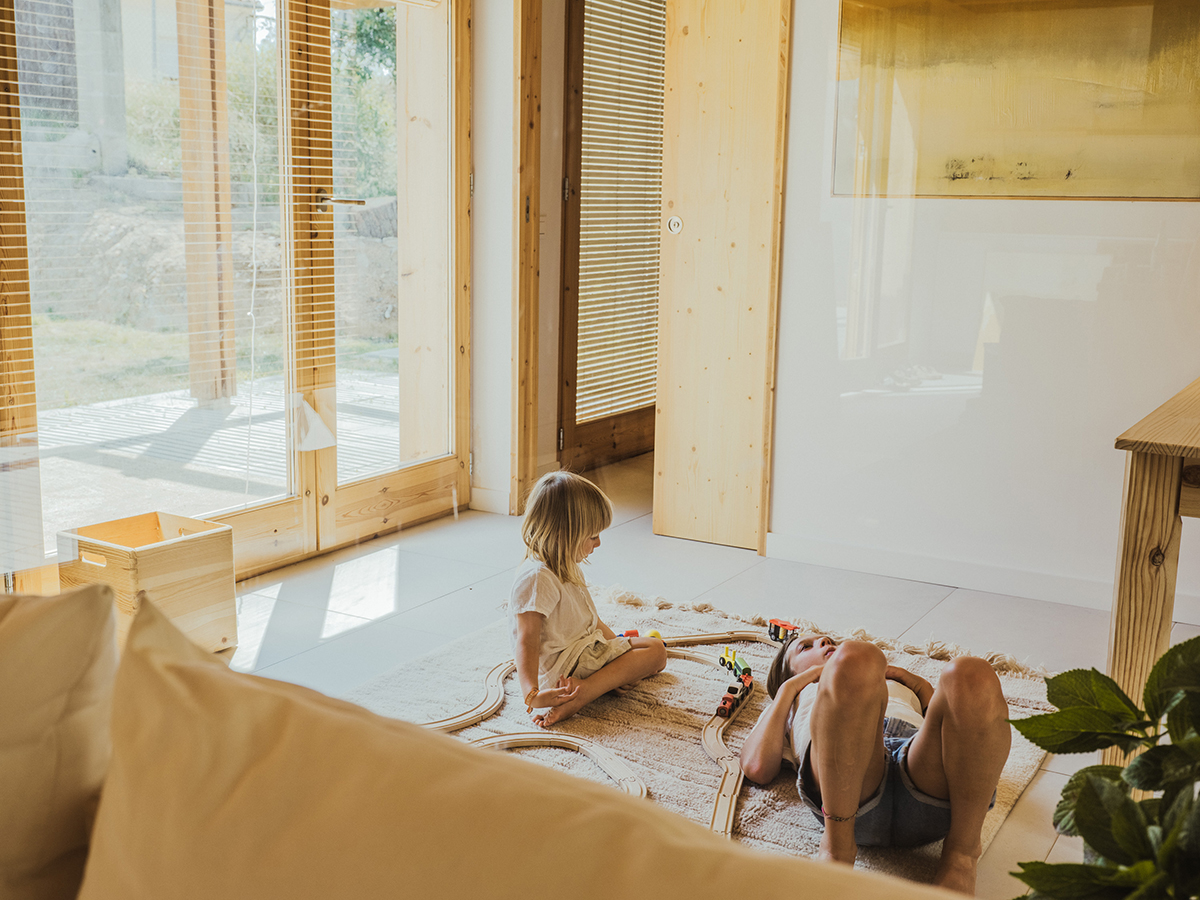
Regarding health, it depends on how the home is built. We may find walls painted with non-breathable plastic paint, walls with damp and mold, indoor environments dried out by heating or air conditioning, or insulation and wood that release formaldehyde—a carcinogenic compound. All these indoor environmental pollutants can generate an “invisible cocktail” that keeps our defenses continuously on alert, causing imperceptible daily wear and tear that, in the long term, can translate into anxiety, fatigue, immune system deficiencies, and even serious illnesses such as cancer or asthma.

What advice would you give to all those people who have not yet dared to build their own ecological or bio-home?


The key lies in understanding that an ecological house is not a luxury or something out of reach: it is, in essence, a well-built conventional home that does not require unnecessary energy consumption to stay warm or cool, and that offers a healthy indoor environment, free of toxins. Understanding what green building is helps to see that these types of projects not only protect the environment but also significantly improve the quality of life for those who inhabit them, ensuring that the initial investment is rewarded with well-being and long-term energy savings.

What factors must be taken into account in green building?


In our studio, we believe that a home must be adapted to the family’s needs, be energy efficient, and be built with natural materials that generate a healthy indoor environment; for us, this defines green building.

Is green building only of interest to those with an ecological conscience?


Here it is useful to differentiate between an efficient house and an efficient house built with natural materials. Most people are interested in what offers them a direct benefit: climate change does not usually affect our daily lives in the short term, so it is difficult for someone without a certain ecological conscience to be motivated to opt for natural or healthy construction, in the same way that not everyone looks for organic products in a supermarket.

However, when we talk about energy efficiency, the range of interested people expands significantly. The short-term benefit of an efficient house is easy to demonstrate: it translates into real savings on heating bills, and this attracts almost any homeowner. Choosing natural materials as well to achieve that efficiency depends both on the person’s ecological conscience and their budget, as it is not always possible to combine efficiency and natural materials without adjusting other aspects of the project.