Materials
Wood Fiber Insulation
Thermal and acoustic insulation with a negative carbon footprint
What is wood fiber?
Wood fiber as an insulating biomaterial is composed, as its name suggests, of tiny fibers obtained from wood waste, including natural elements such as branches, leaves, bark, or sawdust, as well as recycled wood of low commercial value. This material is currently experiencing growth in the market and represents an ecological alternative to petroleum-derived plastic insulation materials, such as XPS (extruded polystyrene) and EPS (expanded polystyrene).
This material not only functions based on the same principle as other insulation materials—a mass of static air trapped by its spongy texture—but also stands out as a versatile and efficient biomaterial in terms of thermal and acoustic insulation. This article explores the evolution of wood beyond its traditional structural use, positioning wood fiber insulation as a leading competitor in sustainable construction.
Wood fiber and its characteristics
Thermal insulation:
Wood fiber is distinguished by its exceptional capacity to provide thermal insulation. The presence of small fibers generates a unique structure that contributes to creating an effective barrier against temperature variations, promoting a stable and comfortable interior environment.
Airtightness:
This biomaterial offers notable airtightness, ensuring that structures built with wood fiber insulation are capable of minimizing unwanted air infiltration.
Energy efficiency:
Wood fiber contributes significantly to the energy efficiency of buildings. By providing effective thermal insulation, it reduces dependence on climate control systems, thereby decreasing energy consumption and associated costs.
Breathability:
The ability of wood fiber insulation to allow transpiration in the structures where it is installed makes it an ideal choice for preventing condensation, thus avoiding health problems derived from the presence of moisture such as asthma. In this way, it contributes to indoor air quality and the health of users occupying living spaces.
Hygrothermal properties:
This refers to a material’s ability to adapt to environmental conditions, regulating humidity and temperature. In the case of wood fiber insulation, it releases and absorbs moisture from the environment, maintaining optimal relative humidity values for user health, which range between 40-60%.
High thermal inertia:
Wood fiber responds to one of the basic principles of bioclimatic design, high thermal inertia, which allows it to retain heat for prolonged periods, contributing to a more stable interior environment.
Acoustic insulation:
In addition to its thermal properties, wood fiber acts as an excellent acoustic insulator thanks to its porosity from its structure of interlaced fibers that absorbs sound waves, contributing to reducing noise transmission between spaces and improving the sound quality of environments.
Recyclable:
Wood fiber is a completely recyclable material, which means that at the end of its useful life it can be reused, composted, or reintegrated into sustainable production cycles, minimizing environmental impact and promoting the circular economy.
Circularity:
This biomaterial aligns with the principles of the circular economy by utilizing wood waste for its production, thus contributing to waste reduction and the efficient use of natural resources. A notable aspect regarding the recyclability of wood fiber is its composition without additives, which prevents the possible migration of chemical substances harmful to health in living spaces or future products derived from this raw material. [1]

Technical characteristics of wood fiber insulation
Formats:
The versatility of wood fiber is reflected in the different formats available, among which tongue-and-groove and machined panels stand out. These formats not only simplify joints during installation, but also contribute to reducing energy losses in the final installation by avoiding thermal bridges. The variety of formats allows wood fiber to be adapted to different needs and architectural configurations, both for facades and roofs or window frames, through panels or blown loose-fill format.
Density:
The density of this insulation material can vary significantly depending on its format, ranging between 40 and 140 kg/m³. [2] This is a technical characteristic that plays a crucial role in its performance depending on its application needs. For exterior insulation that must be anchored directly, support cladding layers, and resist moisture, the use of panels with high and homogeneous density is recommended. On the other hand, for insulation in air cavities between walls, it is possible to use wood fiber granulate directly, also ideal in the case of irregular walls such as stone.
Thermal conductivity:
There are two types of panels with similar thermal conductivity coefficients directly related to their density: flexible panels, with a lambda between 0.038 and 0.04 W/mK, and dense panels, with values from 0.037 to 0.046 W/mK. This variety allows the choice of panel to be adapted according to the specific needs of each project, maintaining an optimal balance between flexibility and density. [3]
Fire resistance:
According to standard EN 13501-1, wood fiber demonstrates Class E behavior against fire. [4] This classification guarantees an adequate level of fire resistance for various construction applications.
Breathability:
Wood fiber is distinguished by its transpiration capacity, evidenced by a µ coefficient of 5. This property is essential for allowing vapor diffusion and sound wave absorption, thus contributing to improved air quality and acoustic comfort in interior spaces.
Production process
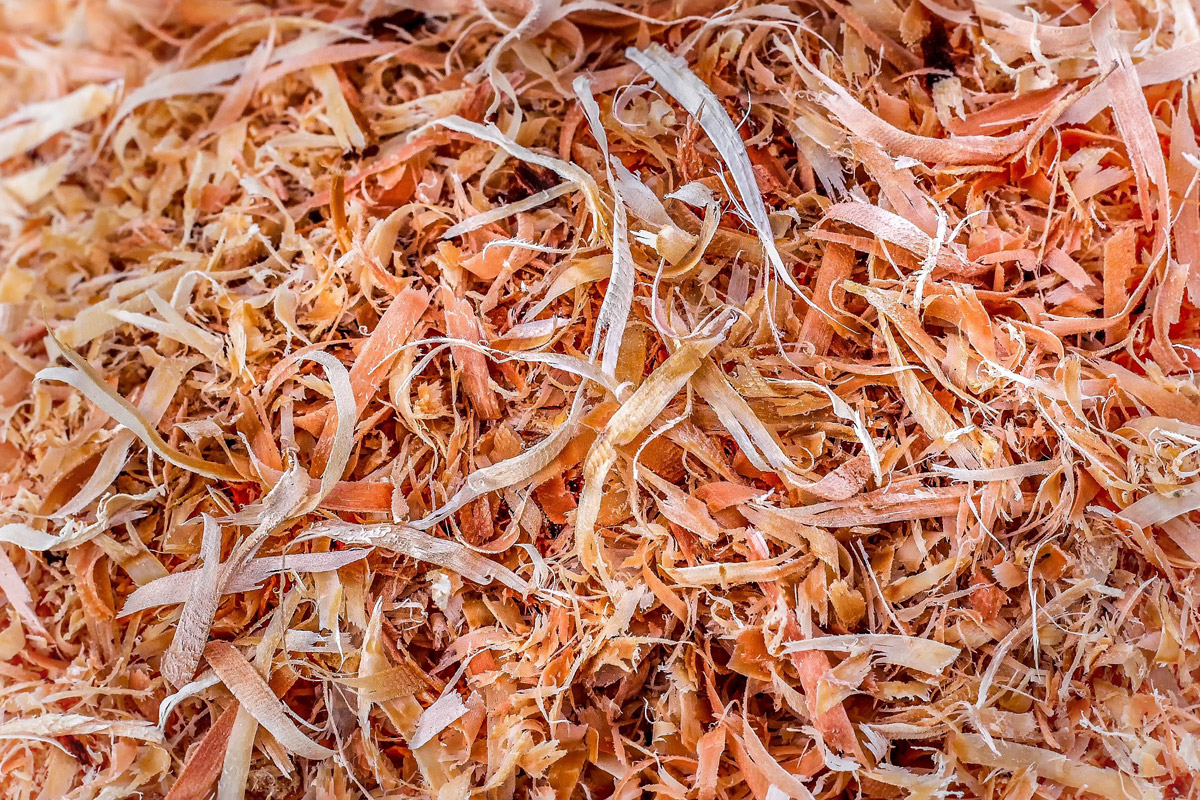
Wood fiber is distinguished by a production process that must guarantee its effectiveness and respect for the environment from the origin of the raw material. Based on the fact that there is a large amount of wood waste that can be reused for the production of wood fiber insulation, it is essential to prioritize this origin that promotes the circularity of the product. Furthermore, the fibers have a lower carbon footprint if they are wood obtained from local forests certified by the Forest Stewardship Council (FSC), which ensures responsible forestry practices and the maintenance of healthy ecosystems.
The process begins with the grinding of wood into particles, which undergo a thermo-mechanical treatment that allows the wood to be separated into individual fibers. This approach preserves the integrity of the fibers that will give the material its efficient technical characteristics. From here, it is possible to leave the fibers loose for bulk application methods or manufacture agglomerated panels of greater or lesser flexibility depending on the pressure applied, a dry process that must avoid the need for harmful chemical substances such as adhesives or additives, contributing to the purity of the final product and minimizing its environmental impact. [5]

Additives
During the manufacture of wood fiber insulation, but also of other natural insulation materials, it is common to incorporate additives such as boron salts, or borax, into the process to confer flame-retardant properties to wood fiber insulation and other biocidal characteristics.
It is necessary to pay special attention to the presence of this toxic substance widely used as a pesticide that is harmful to health, from brief exposure to high amounts of boron salts as well as its bioaccumulation in our body. Studies with animals show that it affects their reproductive capacity as well as organs such as the stomach, intestines, liver, kidneys, and brain. [6] Due to the good fire behavior of wood fiber insulation, it is not essential to use additives that reinforce its flame-retardant capacity.
Application methods for wood fiber insulation
Wood fiber insulation offers various supply options that adapt to different needs. From bulk supplies ideal for blown insulation applications in large quantities, to rigid panels and rolls that facilitate installation in smaller spaces or with less conventional shapes. [7]
The most common application techniques are as follows:
Blown insulation:
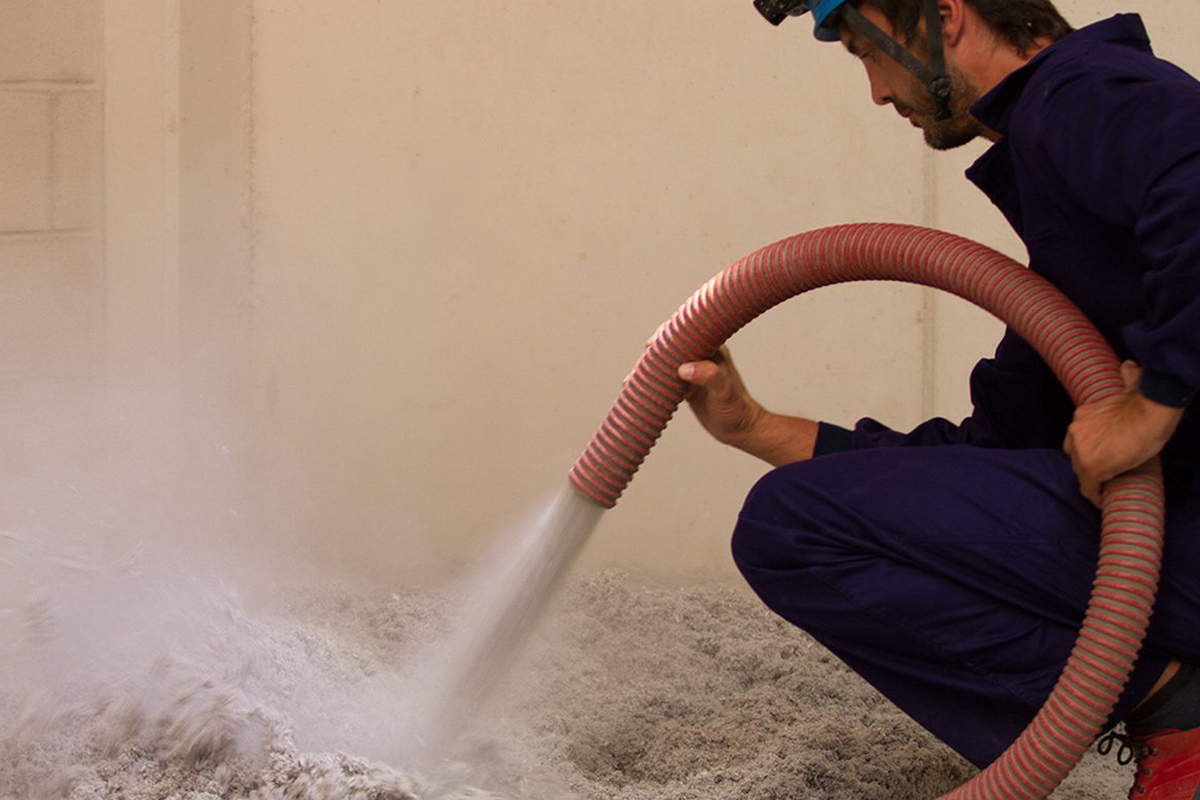
This is a method that requires a specialized machine that introduces bulk wood fiber uniformly into the air cavities of the elements to be insulated, such as walls, floors, or roofs. It is a fast process, carried out on-site, that ensures airtightness at all points. A series of holes are made into which a hose is introduced that is pumped from a motor outside the building, filling each hole until the required density is achieved and finally sealing the openings with paste. [8]
Sprayed insulation:
In this case, wood fiber is mixed with a natural binder that acts as an adhesive and is sprayed onto the building element to be insulated, thus forming a continuous and uniform layer of insulation. This method is commonly used in attics and lofts, standing out for its high heat retention capacity, which contributes to improving the energy efficiency of buildings. Installation is carried out without the need for mechanical fixings or the use of adhesives, simplifying the installation and recovery process while speeding up execution times.
Panels or rolls:
Rigid panels or flexible rolls are easy to handle and can be cut on-site. As a result, installation is quick and precise, but requires some mechanical fixing method using anchors such as staples or nails, bonded system, or mixed.
Their application is very versatile; they can be used on facades (perfect for ventilated facades), under-tile (rain and wind proof), in partitions, and on floors. Thus, for exterior insulation that must support a finishing material, more rigid panels of higher density are more suitable due to mechanical requirements. On the other hand, insulating smaller spaces or less conventional shapes is easier to solve using roll format of lower density.

Ecological footprint
Wood fiber stands as a prominent example of applying the principles of the circular economy, by consistently utilizing waste materials. This process is known as upcycling (upcycling), a form of creative reuse that transforms by-products, waste materials, or unwanted products into new materials with specific functions, such as thermal insulation.
In contrast to other insulation materials more common in construction, such as polyethylene foam or expanded polystyrene, derived from plastic that consume large amounts of fossil fuels for their production and are not degradable, wood fiber allows this ecological impact to be reduced, with which the construction sector has an outstanding debt. [5]
Suppliers in Spain
In Spain, the supply of wood fiber insulation comes mainly from European companies specialized in the manufacture and distribution of this type of biomaterial. A nearby example is the company Buitex Recyclage, based in eastern France, which develops the complete range of hydrophobic rigid insulation called Isonat. Its commercial delegation in Spain, known as Davsa, is located in the province of Girona.
Among the European manufacturers most distributed in Spain, Gutex stands out, a German family business with a history dating back to 1932 and located in the south of the Black Forest. Gutex specializes in the production of various types of boards and bulk wood fiber. The general distributor of Gutex for Spain and Portugal is Biohaus, a company specialized in biomaterials for thermal and acoustic insulation, including products such as cellulose, cork, and wood fiber, as well as natural paints.
Another relevant supplier is Ecogreenhome, which distributes wood fiber products from the manufacturer Steico, a leader in the European market. Steico has offices in Catalonia, Madrid, the Basque Country, and Aragon, also offering innovative products such as beams with integrated lateral insulation. [9]
Pavatex, on the other hand, offers a wide range of formats, thicknesses, and combinations in its fiberboard panels, manufactured at its plant in Cham, Switzerland. These companies represent outstanding options in the Spanish market for those seeking sustainable and efficient wood fiber insulation solutions.
BIBLIOGRAFÍA