Materials
Cellulose Insulation
Optimizing Indoor Comfort with Natural Materials

In the construction sector, natural insulation materials are gaining ground as efficient and environmentally friendly alternatives. Within this trend, cellulose insulation stands out for its efficiency and low environmental impact. Increasingly, natural and recycled materials are replacing traditional products, whose manufacturing is often intensive and less sustainable.
Cellulose insulation is a biomaterial derived primarily from recycled paper, such as post-consumer newsprint, giving it a high recycled content and a significantly smaller ecological footprint than other conventional materials. Furthermore, it contributes to the circular economy by reducing waste and promoting resource reuse. Thanks to its thermal and acoustic properties, it improves the energy efficiency of buildings, reducing energy consumption and, consequently, carbon emissions.
Given the growing priority of sustainability, renewable materials like cellulose, a byproduct of forests—major carbon sinks—are presented as an excellent option. However, challenges associated with monocultures and forest management make recycled biomaterials like cellulose increasingly relevant. These not only mitigate the environmental impact of construction but also contribute to reducing embodied carbon, which is key to achieving carbon neutrality in the sector.
Below, we explore the advantages, characteristics, and applications of cellulose insulation, and its role in the future of sustainable construction.
What is CELLULOSE?
Cellulose is a natural material that has been used as insulation since the late 19th century, particularly in America. Although its use became popular during the 1970s oil crisis due to its effectiveness and sustainability, its market presence later declined due to campaigns questioning its fire-retardant properties. However, today, cellulose is recognized as an efficient and ecological option for thermal and acoustic insulation.
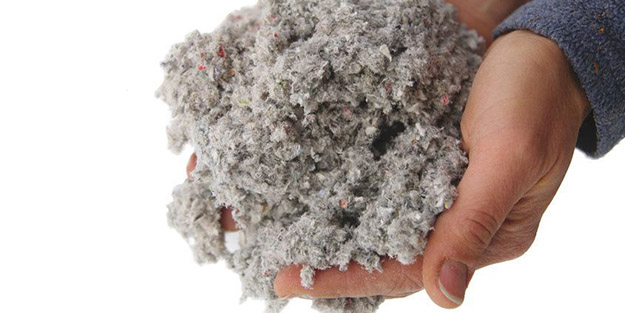
This material shares many similarities with wood fiber, as both originate from wood and contain cellulose as their main component. Cellulose, a key molecule in plant cell walls, is present in large quantities in paper and cardboard, allowing its manufacturing to be based on paper recycling, particularly newsprint. The production process includes shredding the paper, mixing it with water to form a pulp, extracting the ink, and adding additives such as boron salts, which provide fire-retardant, insecticidal, and fungicidal properties.
The final product can be presented in blankets or in the form of cellulose wadding, which is applied in bulk using blowing or insufflation techniques. Its insulating capacity is notable, with a thermal conductivity coefficient ranging between 0.038 and 0.044 W/m·K, comparable to other insulating materials.
From an ecological perspective, cellulose stands out for its high recycled content, which can reach 75-85% post-consumer newsprint and approximately 15% fire retardants, such as boric acid. In comparison, other materials like fiberglass only achieve a maximum of 50% recycled content. Furthermore, cellulose is characterized by its low toxicity and the reduced environmental impact of its raw materials, consolidating it as a sustainable option for building and renovation.
Advantages of Cellulose Insulation
Cellulose insulation stands out as a versatile and sustainable solution for construction, offering properties that make it a competitive alternative to other insulating materials. Its main advantages are described below:
Circularity: Cellulose insulation is a deeply environmentally friendly material, manufactured primarily from recycled paper, such as post-consumer newsprint. It is not only a recycled product but also recyclable, positioning it as a key option within the circular economy. Its production significantly reduces waste, promotes recycling, and leverages existing resources.
Energy Efficiency: Due to its low thermal conductivity, cellulose provides exceptional thermal insulation. This translates into a reduced need for energy for climate control, lowering the energy consumption of buildings.
Thermal Inertia: Thanks to its high density and heat storage capacity, cellulose provides remarkable thermal inertia. This is especially useful during summer months, as it helps maintain cooler indoor temperatures by delaying heat transfer.
Fire Resistance: Although not completely incombustible, cellulose possesses fire-retardant properties that make it safe in case of fire. Under high temperatures, it forms a carbonized layer that acts as a protective barrier, delaying the spread of flames. Additional treatments increase its fire resistance.
Hygroscopicity: Cellulose can absorb and release moisture, helping to balance the ambient level within buildings. This property improves indoor comfort, although it requires precautions in areas exposed to water infiltration, where adequate waterproofing would be necessary.
Pest Control: The additives used in its manufacturing, such as boron salts, effectively prevent mold growth and insect infestation, ensuring the material’s durability over time.
Together, these properties make cellulose a sustainable, efficient, and ecological option, ideal for construction and renovation projects that seek to combine functionality with environmental respect.
Technical Characteristics of Cellulose Insulation
Cellulose insulation offers outstanding technical performance, supported by specific properties that make it suitable for various construction applications:
Low Thermal Conductivity: It has a thermal conductivity coefficient of 0.038-0.039 W/m·K, making it an excellent insulator, comparable to mineral wool (0.037 W/m·K). [3]
High Thermal Resistance: Its density and heat storage capacity provide superior thermal resistance compared to other materials.
Good Fire Behavior: Classified as Euroclass Bs2-d0, cellulose exhibits fire-retardant properties thanks to treatments with boron salts, which enhance its safety in case of fire.
Acoustic Insulation: The material’s structure provides high performance in noise absorption, improving the acoustic comfort of interior spaces.
Specific Heat: With a value of 2110 J/kg·K, cellulose has a remarkable capacity to store and release heat, contributing to its high thermal phase shift.
Thermal Phase Shift: In thicknesses of 200 to 250 mm, it can achieve thermal phase shifts of up to 12 hours, ensuring more stable indoor temperatures day and night.
Non-Hydrophilic Material: Although hygroscopic, cellulose does not directly absorb water, minimizing degradation risks under appropriate use conditions.
These technical characteristics make cellulose a practical and efficient option for meeting thermal, acoustic, and sustainability demands in modern construction. [4]
VERSATILITY OF CELLULOSE INSULATION
Cellulose insulation is a highly adaptable material, with formats and application methods that allow its use in both new constructions and renovations. This flexibility facilitates its integration into various projects, offering customized solutions according to needs. The available formats are:
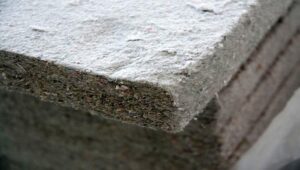
Batt Type: Similar to fiberglass or rock wool batts, for traditional installations.
Loose-fill Cellulose: Ideal for dry-filling cavities or horizontal surfaces.
Sprayed Cellulose: Applied by adding a small amount of moisture that evaporates quickly within 24 to 48 hours.
Installation Methods
Correct installation of cellulose insulation is essential to ensure its optimal performance. These techniques allow for maximizing the material’s properties, guaranteeing effective insulation without thermal or acoustic interruptions. It is crucial to have a certified and experienced installer who can ensure precise and effective placement. [5]
There are three main methods for applying cellulose insulation, each designed to meet different construction and rehabilitation requirements:
Blown-in (Insufflation)
The blown-in system is especially suitable for filling air cavities in walls. It involves drilling small holes in the interior wall or exterior facade and using a pressurized air system to uniformly introduce cellulose insulation into the empty spaces. This process ensures complete coverage of the cavity, eliminating any possibility of thermal bridges. Once the application is complete, the holes are sealed to restore the surface. This method is fast and clean, allowing a standard apartment to be insulated in a single day, and is an effective solution for both new construction and renovations.
Sprayed
Wet-spray cellulose application is an ideal technique for new construction. It involves applying the material directly onto the surface with a mixture containing a small amount of water, which evaporates within a short period, between 24 and 48 hours. In this case, the insulation completely covers walls or ceilings, forming a continuous layer. Subsequently, the interior partition is erected, or if the enclosure is made with plasterboard, a roller is used to level the material to the height of the profiles before installing the boards. This technique is particularly effective in ensuring uniform and uninterrupted insulation, especially in vertical structures.
Loose-fill (Blowing)
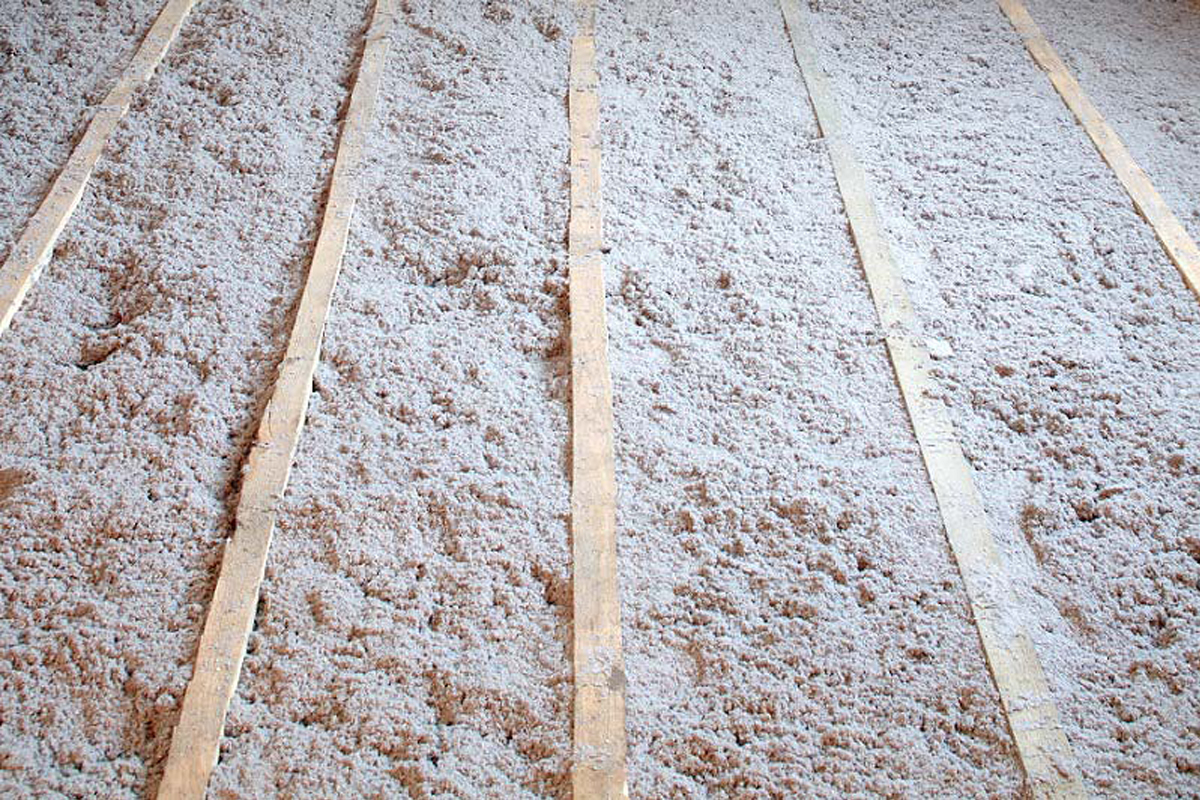
The blowing system is ideal for horizontal areas, such as under roofs in homes. With this method, cellulose is applied using a hose that distributes the material uniformly over the floor, creating a continuous blanket of insulation. This technique ensures complete coverage of the surface, without empty spaces or thermal bridges, making it an excellent option for guaranteeing thermal comfort in areas difficult to reach by other methods.
Each of these application methods allows cellulose insulation to be adapted to different architectural needs, maximizing its effectiveness in various contexts and types of construction. Furthermore, its installation does not require invasive works or the use of chemical binders, which simplifies its implementation and reinforces its sustainable character.
Ecological Footprint of Cellulose in Construction
Cellulose insulation is presented as a highly effective ecological alternative to traditional materials such as mineral wools or chemical foams. Its manufacturing from recycled paper, mostly post-consumer newsprint, gives it a significantly smaller ecological footprint. With a recycled content that reaches up to 75% of its composition, cellulose not only offers excellent thermal and acoustic insulation but also directly contributes to the circular economy.
In addition to its low environmental impact during manufacturing, cellulose helps reduce energy consumption in buildings thanks to its high insulation performance. Its R-value, ranging between 3.6 and 4.0 (21-26 RSI/m), positions it as a material with superior performance compared to other insulators. This translates into a significant decrease in the need for energy for climate control, which reduces both energy consumption and the carbon footprint of constructions.
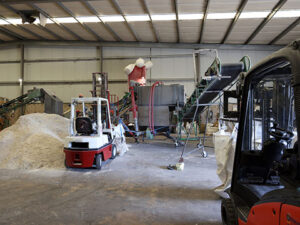
Another important aspect of cellulose is its low embodied energy. The manufacturing process of cellulose requires less energy than other materials, which also contributes to reducing its ecological footprint. Furthermore, being completely recyclable, it can be recovered and reused at the end of its useful life, provided it is not contaminated. In case of fire, if the cellulose has not been degraded by chemical substances, it could even be recycled again, which reinforces its sustainable nature.
This approach to reuse and recycling is a great advantage in modern construction, as it responds to the growing demand for ecological materials that can be efficiently reincorporated into the life cycle of buildings, minimizing environmental impact once the building’s useful life ends. Cellulose, as part of this trend, establishes itself as an ideal option for those seeking to build more sustainably, without compromising technical performance. [6]
Suppliers in Spain
In Spain, several cellulose insulation suppliers are promoting the use of this sustainable material in construction, offering innovative and environmentally friendly solutions. Some of the main players in the market are detailed below:
Aislanat (Madrid): Aislanat is a family business that, in 2021, was awarded the Sustainable Company prize for its promotion of sustainability and the circular economy. It specializes in the manufacture and installation of cellulose wadding.
Aisedecel (Zamora): In the province of Zamora, Aisedecel manufactures and markets a range of cellulose insulation in batt or loose-fill form. This cellulose has been treated to be water-repellent, significantly reducing its water absorption, which improves its performance against humidity. Their treated cellulose goes from a water absorption of 16-35 liters to 2.5-4.5 L. Furthermore, it complies with UNE-EN 1906:2013 regulations on water absorption and vapor.
Biohaus (Navarra): Biohaus is a distributor of natural insulation materials such as cork, wood fiber, and cellulose. At its plant in Alsasua, they manufacture Biocell, their own brand of loose-fill cellulose, which contains 90% recycled cellulose and holds the European Technical Approval (ETA 04/0080).
Isocell (International): Although there are no Spanish manufacturers that produce cellulose as widely as in other countries, many companies market products derived from Isocell, an international brand with factories in Austria, France, and Belgium. Isocell is known for its high-quality cellulose, which is widely distributed in the European market.
These suppliers contribute to the growing adoption of cellulose as an ecological and efficient insulation material, supporting the transition towards more sustainable constructions with a lower environmental impact.
BIBLIOGRAFÍA