Slow Studio featured in NAN Arquitectura magazine’s sustainability special
The magazine NAN Arquitectura y Construcción includes Slow Studio in its latest issue, number 195, Sustainability Special, in a report titled Sustainability in Architecture: From Efficiency to Systemic Change. This feature brings together various firms and professionals to reflect on how the concept of sustainability is evolving in today’s architectural practice.
The article presents a broad analysis of architecture’s role in the face of current environmental challenges, addressing issues such as the life cycle of buildings, material sufficiency, territorial resilience, and professional responsibility in resource use. Drawing on reflections from different studios, the report outlines a landscape where sustainability is no longer understood solely as energy efficiency, but as a cultural and disciplinary framework that guides projects from the very first decisions.
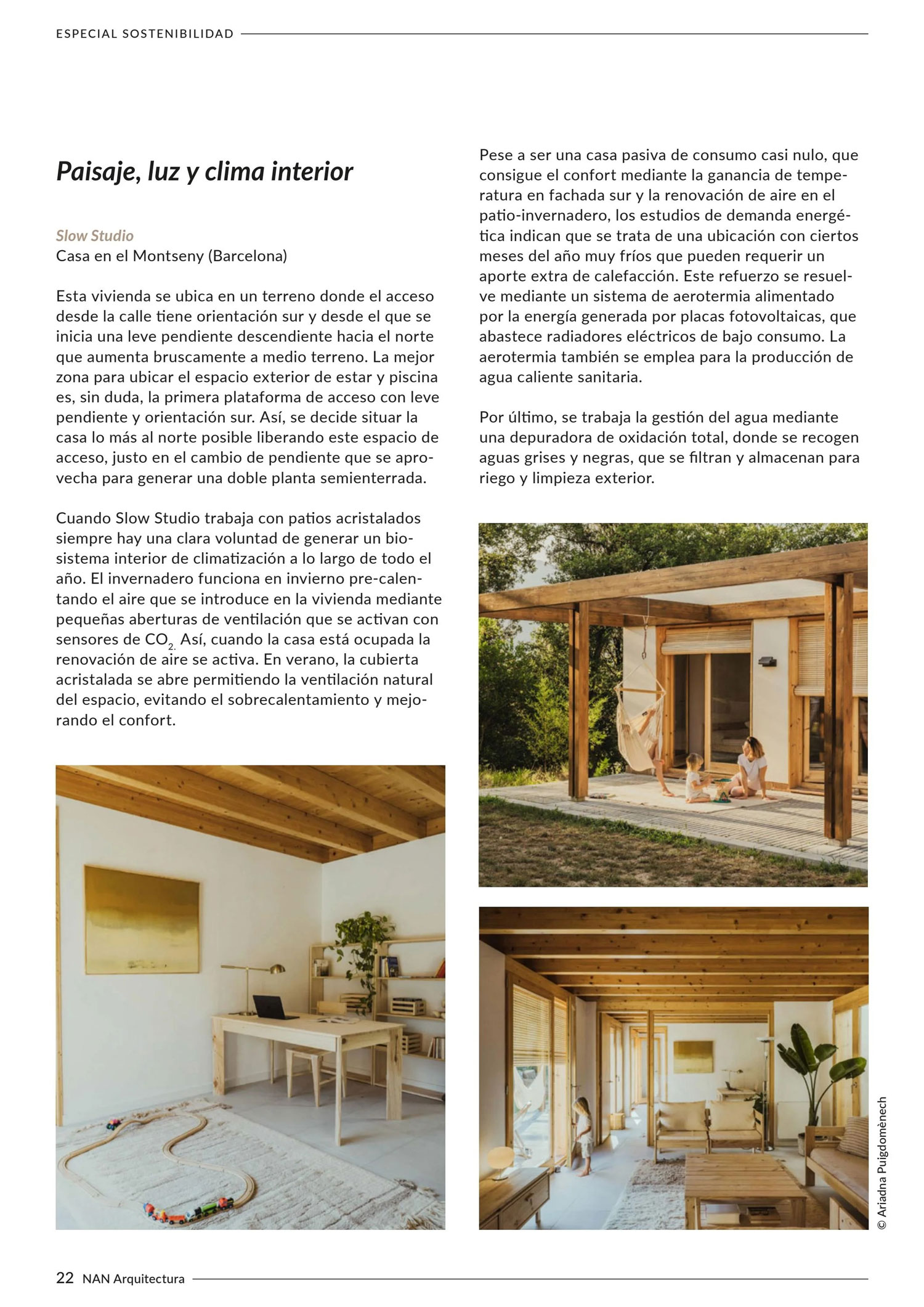
In this context, Slow Studio contributes a reflection on the relationship between architecture, resources, and professional responsibility. As explained in the report, sustainability is not proposed merely as a set of indicators or certifications, but as a profound revision of how architecture relates to a planet of finite resources and the impact that construction generates on ecosystems and human health.
The article also focuses on the importance of the initial project phases as a key moment for making decisions that determine the consumption of materials, energy, land, and water associated with a building. In this regard, Slow Studio advocates for the concept of sufficiency, understood as the search for solutions that respond to real needs while minimizing resource demand and environmental impact.
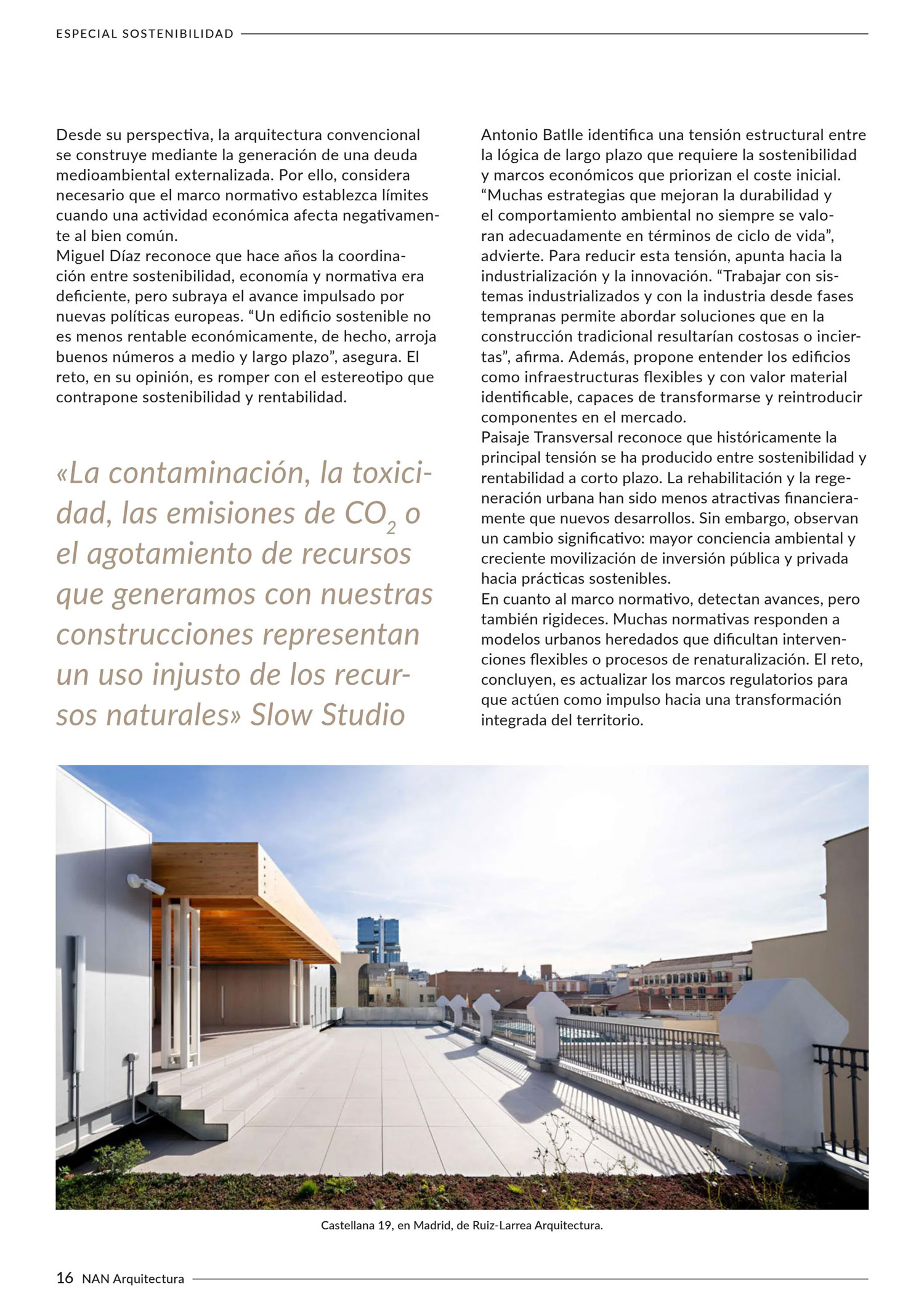
The special also brings together contributions from other firms such as Ruiz-Larrea Arquitectura, Picharchitects, and Paisaje Transversal, offering a pluralistic view of the profession’s current challenges and the evolution of the sustainability discourse toward a more comprehensive vision that incorporates the full life cycle of buildings, material circularity, and resilience against climate challenges.
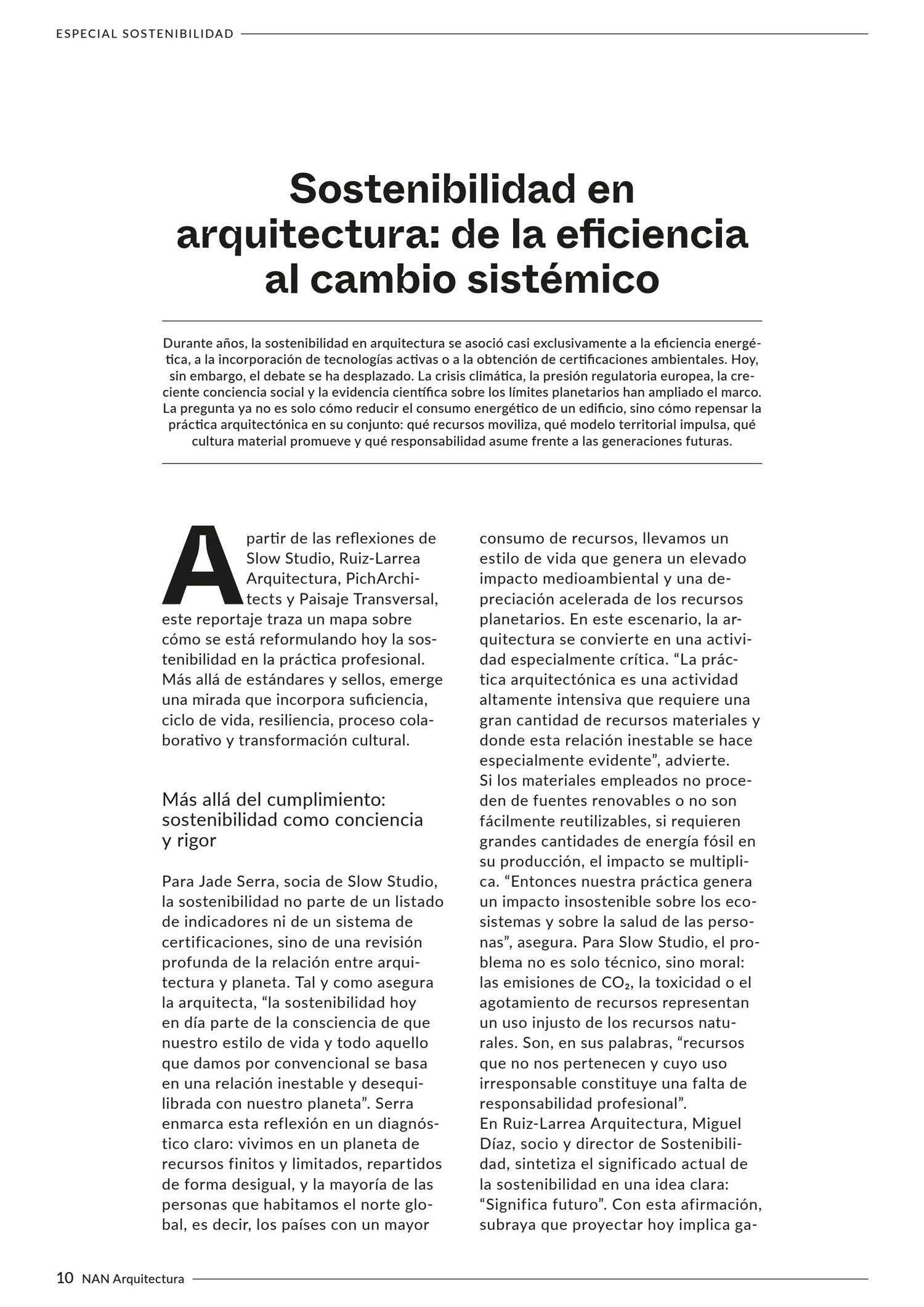
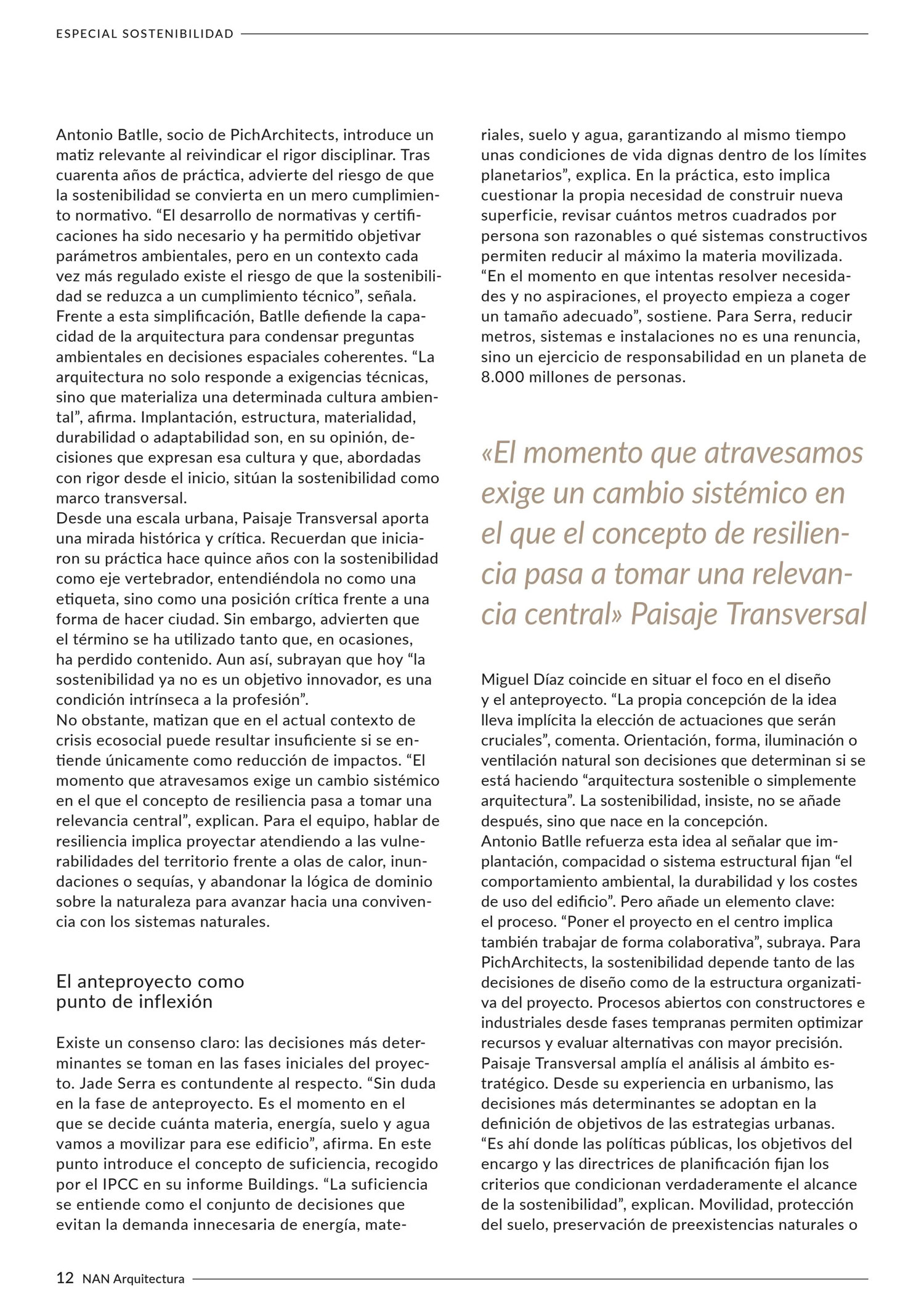
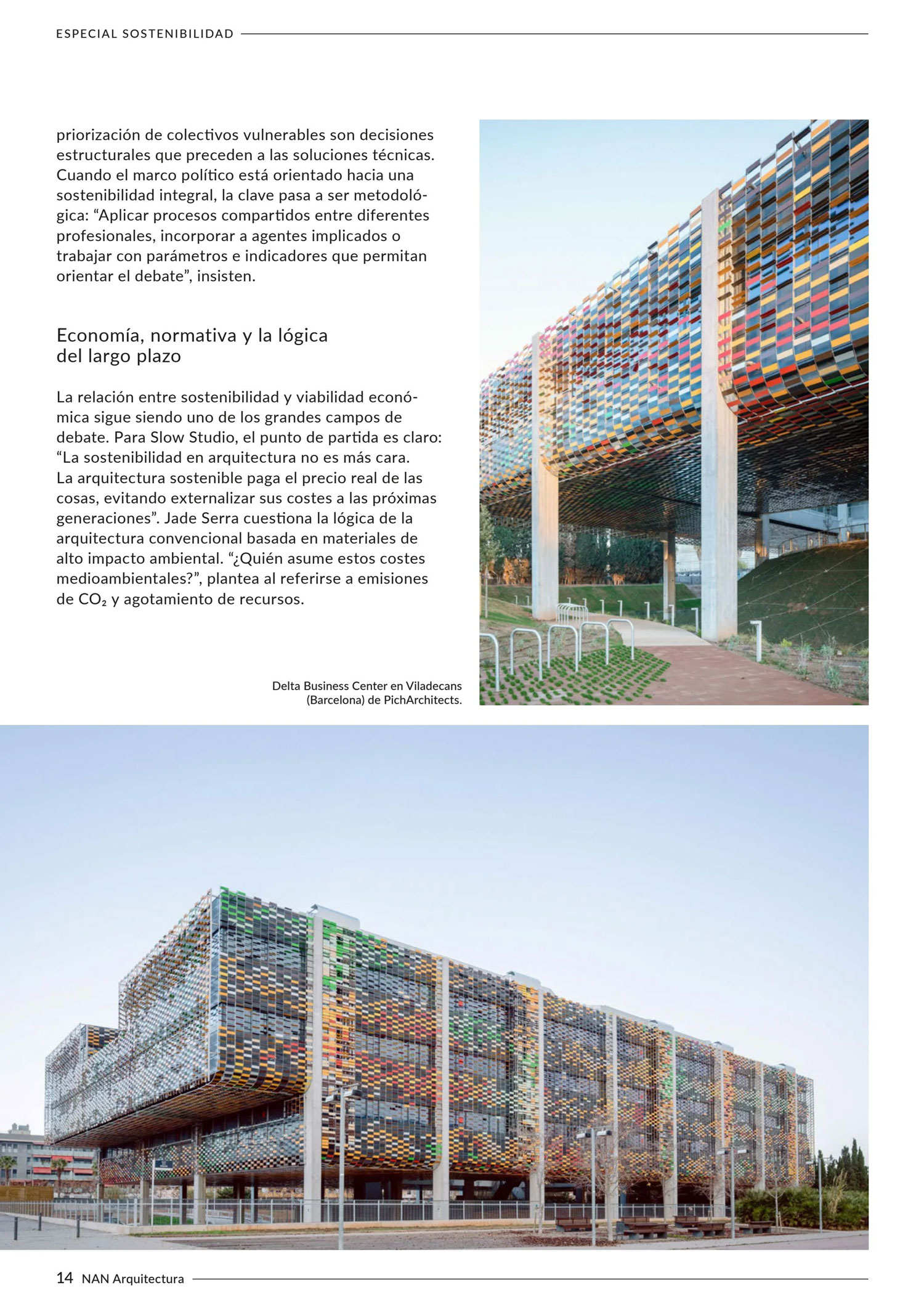
What does sustainability mean in architectural practice today, beyond standards or certifications?
Sustainability in architecture today stems from awareness. It comes from the realization that our lifestyle and everything we consider conventional is based on an unstable and unbalanced relationship with our planet. And like any unstable relationship, it eventually collapses in the form of climate crises, loss of biodiversity, and the degradation of the ecosystems that sustain our lives.
We live on a planet of finite and limited resources, distributed unequally, and most of us living in the Global North—that is, countries with the highest resource consumption—lead a lifestyle that generates a high environmental impact and an accelerated depreciation of planetary resources.
Architectural practice is a highly intensive activity that requires a vast amount of material resources, and it is where this unstable relationship becomes especially evident. If these materials do not come from renewable or highly available sources, if they require large amounts of fossil energy in their production processes, and if they are not easily recoverable, reusable, or returned to the earth at the end of their useful life, then our practice generates an unsustainable impact on ecosystems and human health.
And this impact is not free; it becomes a mortgage for future generations. The pollution, toxicity, CO₂ emissions, and resource depletion we generate with our constructions represent an unfair use of natural resources. These are resources that do not belong to us; they sustain our lives and those of future generations. Making irresponsible use of such a precious asset is a failure of professional responsibility.
In which phases of the project do you believe the most decisive decisions are made from an environmental and social perspective?
Undoubtedly in the preliminary design phase. This is the moment when it is decided how much matter, energy, land, and water we are going to mobilize for that building. The first premise is sufficiency. According to the IPCC definition in its Buildings report, sufficiency is understood as the set of decisions that avoid unnecessary demand for energy, materials, land, and water, while ensuring decent living conditions within planetary boundaries.
In practice, this translates into asking ourselves what resources and how much surface area are truly necessary to carry out an architecture that ensures a dignified, responsible, and conscious life, without abusing our corresponding share of resources and energy as human beings. In practical terms, this involves questioning whether we need new built surface area or if we can renovate, how many square meters per person are reasonable, or which construction systems allow us to minimize the matter and energy mobilized.
This involves reducing to the essentials: reducing meters, construction systems, installations, and finishes, but also reviewing cultural patterns of space use, comfort expectations, and consumption.
On a planet of 8 billion people with limited resources, the key question is what amount of space and materials is sufficient per person to guarantee dignified conditions of habitability, health, and access to green, cultural, and educational spaces. The moment you try to solve needs rather than aspirations, the project begins to take on an appropriate size.
What tensions or contradictions do you detect between sustainability, economic viability, and the regulatory framework?
For us, the first premise is to start from the fact that sustainability in architecture is not more expensive. Sustainable architecture pays the real price of things, avoiding the externalization of its costs to future generations and the millions of people who suffer the consequences of climate change today.
The pertinent question would be what contradictions we find between so-called conventional architecture and environmental justice.
When I decide to build with high-environmental-impact materials that require large amounts of fossil fuels in their production processes, such as concrete, steel, or plastics, I am generating an impact in the form of CO₂ emissions, pollution, and resource depletion.
Who assumes these environmental costs?
Conventional architecture is built by generating debt. An environmental debt externalized to those who will come after.
But yes, we must talk about costs, and for us, the way forward is not to complain and lament, but to fight and raise our voices to stir consciences and ensure that our clients and developers choose life and health over economic profit or aspirations.
Regarding the regulatory framework, there is much work to be done to regulate and promote the decarbonization of the sector. When an economic activity is negatively affecting the health and well-being of people and the planet, regulation must appear to safeguard the common good. If I, as a developer, decide to build a building of concrete, steel, and plastic to maximize my profit and thereby generate a negative impact on the planet in the form of CO₂ emissions, a limit must be set here to safeguard the common good of our generation and future generations.
Do you believe that the discourse on sustainability is evolving toward more comprehensive, realistic, and broader approaches? In what sense?
Yes, undoubtedly. When we began to disseminate information about sustainability more than 10 years ago, there was already more or less a consensus that architecture had to be energy-efficient, reducing the operational carbon emitted by our buildings. In recent years, the need to also talk about embodied carbon has become evident—that which is produced during the extraction and transformation processes of industrialized construction materials and which incorporates high amounts of CO₂ before a building is even opened.
But perhaps the most urgent thing is to initiate the debate on the change of consciousness involved in evaluating our decisions as professionals from the perspective of awareness and sufficiency. The awareness that our actions have an impact on the future of people and the planet, and that the solution lies in understanding that less is enough.
Sufficiency here is not just a technical issue, but also a cultural one. It has to do with accepting that we can live well with less surface area per person, with better-shared buildings, with less material consumption, and with comfort expectations more aligned with the planet’s climate reality, opening the door to a much more honest and responsible architectural practice.
You can read the full report Sustainability in Architecture: From Efficiency to Systemic Change at the following link.