Aerothermal Energy in Arquitectura y Diseño Magazine
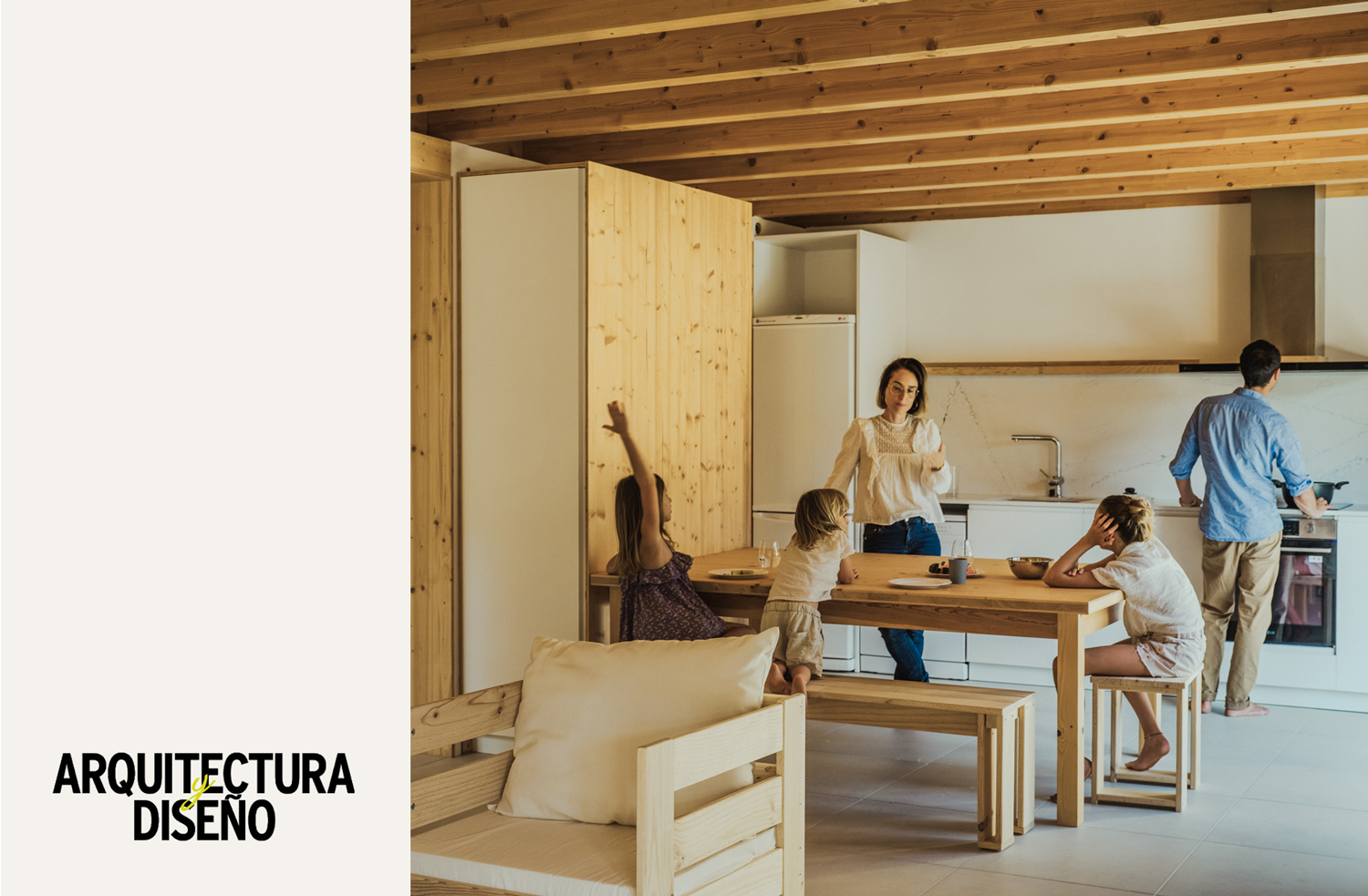
This month, Arquitectura y Diseño magazine publishes the article “What aerothermal energy is and how much money is saved by installing it,” which analyzes this renewable technology as one of the most efficient solutions for home climate control, reducing energy consumption and CO₂ emissions.
The report explains how aerothermal energy harnesses the energy contained in the outdoor air to generate heating, cooling, and domestic hot water, highlighting its role as a sustainable alternative to traditional gas or oil systems.
At Slow Studio, specializing in sustainable housing and passive design, we share our vision on the use of aerothermal energy and its integration into architectural projects focused on energy efficiency and well-being. You can read more in our article What is aerothermal energy in a home?
Am I correct in stating that, in general, combining aerothermal energy with solar panels results in greater energy efficiency and better performance (partly because the dependence on electricity is lower)?
Yes, you are correct. Combining aerothermal energy with solar panels is currently the most efficient and cost-effective option for domestic hot water production.
Aerothermal systems run on electricity, and when powered by photovoltaic energy, grid dependency is significantly reduced and the overall system performance increases. In fact, energy performance can be remarkably improved when both systems are correctly integrated.
However, from our bioclimatic and passive architecture approach, we understand that aerothermal energy is not exactly an “alternative,” but simply the best tool available for heating domestic hot water (DHW).
In a Mediterranean climate, where passive design achieves thermal comfort without the need for active systems, it makes no sense to use aerothermal energy as the primary heating or cooling system.
We do not use any active climate control systems—no radiators, no underfloor heating, and no air conditioning. We work exclusively with passive principles, which are what guarantee efficiency and true well-being within a home. The six bioclimatic principles on which our work is based are:
Solar gain and protection: harnessing solar radiation in winter to heat interior spaces, and protecting against it in summer through eaves, louvers, pergolas, or deciduous vegetation.
Thermal inertia: using materials with high thermal storage capacity (earth, stone, or concrete walls) that accumulate heat in winter and coolness in summer, stabilizing indoor temperatures.
Thermal insulation: reducing heat loss or gain with well-insulated envelopes that minimize exchange between the interior and exterior.
Airtightness and absence of thermal bridges: correctly sealing the building envelope to prevent air infiltration and localized thermal losses.
Controlled air renewal: ensuring continuous and efficient ventilation that maintains good indoor environmental quality without energy loss.
Cross ventilation: designing the home to take advantage of natural air currents, especially in summer, generating thermal comfort passively.
Therefore, true efficiency lies not in the machine, but in the architectural design.
The problem we see today is that many people install aerothermal systems and connect them to air systems for heating and cooling, and that is a mistake: these are active systems that heat the air, a medium that is energy-inefficient and, furthermore, unhealthy.
Hot air dries out the environment, reduces relative humidity, irritates mucous membranes, weakens defenses, and creates artificial, momentary comfort. In contrast, a home designed with passive strategies maintains stable temperatures year-round without the need to spend energy.
Therefore, aerothermal energy is indeed very efficient, but it should only be used for what actually makes sense: producing hot water.
In well-designed Mediterranean climates, we do not need active heating; and if in very specific cases thermal demand requires it (for example, in mountain areas or with low solar radiation), it can be resolved with electric radiators connected to solar panels, without the need for complex or expensive systems.
Some of the advantages of aerothermal energy are that it is a simple installation with a medium-low payback period, but what other two or three would you highlight?
I agree that one of its main advantages is the ease of installation and its good economic return, but I would add three more key points:
Maximum energy efficiency: aerothermal systems extract energy from the outdoor air, generating up to 70% free energy compared to 30% electrical input. If that 30% comes from solar energy, the balance can become practically neutral.
Versatility and compatibility with renewable energies: it can be easily integrated with photovoltaic systems and adapted to different distribution systems (water, low-emissivity radiators, radiant walls, etc.), although we insist that not all are equally consistent in bioclimatic terms.
Low maintenance and long service life: it requires no fuel, no complex inspections, and no thermal energy storage beyond the buffer tank. It is a clean, stable system with high durability.
Even so, I like to insist that technology is no substitute for architectural design.
The first step must always be to reduce energy demand through passive strategies; only when that minimum demand cannot be met naturally is it justified to incorporate an active system like aerothermal energy.
Ultimately, aerothermal energy is an excellent technology, but not a universal solution.
In Mediterranean climates, good passive design ensures that the building stays warm in winter and cool in summer without the need for active systems. Therefore, for us, aerothermal energy is not an alternative; it is a specific and concrete tool: the best option for heating domestic hot water, and nothing more.