Sustainability
10 books on architecture, health, and climate change in 2026
The Slow Studio team's annual selection

Today we are sharing our selection of 10 reads that have accompanied and inspired us over the past year. Books that, from different perspectives, help us better understand the environmental and ecological crisis we are immersed in, and the role architecture can play in this context.
To mark Sant Jordi in Catalonia and International Book Day on April 23, we have brought together a series of titles that go beyond the architectural discipline to address key issues such as planetary boundaries, social justice, the economic model, and the relationship between people and their environment.
In the face of the climate crisis, it is increasingly clear that improving how we build is not enough: we need to rethink how we live, how we organise ourselves, and which values guide our decisions. In this sense, these reads are tools to broaden our perspective and act with greater awareness.
We have structured this selection into four thematic blocks that allow us to address the complexity of the current moment at different scales.
On the one hand, a first block focused on rethinking the society we live in, with books that challenge the economic system, the pace of life, and the values we take for granted. On the other, a set of reads aimed at understanding the climate crisis and the planet’s limits, which help us grasp the ecological foundations of the context in which we operate. We also include a block dedicated to architecture as an agent of transformation, exploring how the discipline can respond proactively to environmental and material challenges. Finally, we have brought together a series of reads that focus on the human dimension of architecture, placing wellbeing, care, and everyday life at the centre of the project.
1. The Divide — Jason Hickel
2. The Myth of Normal — Gabor Maté
3. In Praise of Slow — Carl Honoré
4. Carbon: A Book of Life — Paul Hawken
5. Going for Zero — Carl Elefante
6. Forest First — Kiel Moe
7. Climatic Architecture — Philippe Rahm
8. Reuse of Architectural Components — Bailey Bestul
9. Special Issue: Building with Earth – Ecohabitar Magazine
10. Form Follows Love — Anna Heringer
Rethinking the society we live in
Before intervening through architecture, it is necessary to question the framework in which we operate. The following books help us understand the economic and cultural dynamics that shape the way we inhabit, calling into question many of the standards we take for granted. Through a critical view of the system and the pace of contemporary life, they raise the need to rethink how we organise ourselves as a society, incorporating a more conscious and balanced relationship both with people and with the environment.
1. The Divide — Jason Hickel
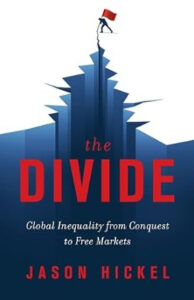
Jason Hickel is an economic anthropologist and one of the most influential thinkers in today’s debate on development and degrowth. His work challenges the global economic model from a critical perspective, focusing on structural inequalities between the Global North and the Global South.
In his latest book The Divide, Hickel offers a critical reading of the global economic system, dismantling some of the most widespread ideas about development and progress. Drawing on historical and economic data, the author shows how inequalities between the Global North and the Global South are not accidental, but the result of a structural system based on resource extraction and relationships of dependency.
Far from offering an abstract critique, Hickel shows how flows of wealth, energy, and materials follow a deeply unequal logic, in which the growth of some territories depends on the impoverishment of others. This analysis compels us to question the dominant development model and, with it, the ways we produce, consume, and build.
In the field of architecture, this reflection is particularly relevant. Understanding where materials come from, what impacts they generate, and under what conditions they are produced is part of a more conscious practice—one that cannot be separated from the system it is part of.
2. The Myth of Normal — Gabor Maté

Gabor Maté is a physician and internationally recognised author for his work on trauma, mental health, and society. Through his books, he analyses how social, economic, and cultural dynamics directly affect people’s physical and emotional wellbeing, highlighting the relationship between environment and health.
In The Myth of Normal, Maté challenges many of the foundations on which contemporary society rests, from the organisation of work to parenting and social dynamics. The book argues that what we consider “normal” is not necessarily healthy, but often responds to structures designed around economic and productive interests rather than collective wellbeing.
Through a combination of clinical cases, research, and critical reflection, the author shows how these dynamics create profound imbalances in physical and mental health, normalising situations of stress, disconnection, and distress. This perspective is particularly relevant for understanding the context in which we live and design, as it places at the centre the need to build environments—including architectural ones—more aligned with people’s real needs.
3. In Praise of Slow — Carl Honoré

This book introduces a fundamental reflection on time, a dimension inseparable from the way we inhabit. Carl Honoré is a journalist and one of the leading advocates of the global Slow movement, focused on challenging the culture of speed and promoting a more balanced relationship with time across different areas of life. In this book, he questions the constant acceleration that defines our societies and proposes a culture of slowness as a necessary alternative.
Across multiple areas—from work to food and education—the author shows how speed has become an unquestioned value, often at the expense of quality, attention, and wellbeing. In this context, slowness does not appear as a renunciation, but as a form of resistance against dynamics that erode everyday life.
Applied to the built environment, this approach invites us to rethink architectural processes: from design timelines to material durability and the way we inhabit spaces.
In this context, this reflection connects directly with our way of understanding architecture. It is no coincidence that we are called Slow Studio. Against the logic of immediacy, we advocate for slower, more conscious processes that are more attentive to what matters most: place, materials, people, and time.
“The clock is the operating system of modern capitalism. The ruling classes promoted punctuality as a civic duty and a moral virtue, while denigrating slowness and lateness as deadly sins.”
At first it was only the workplace, but now it has contaminated every sphere of our lives, like a virus: the way we eat, how we raise children, relationships, sex… we even speed up leisure. We live in a society where we take pride in filling our diaries to breaking point. Our culture instils in us the fear of wasting time, but the paradox is that acceleration makes us waste our lives.
Today everyone suffers from Time Sickness: the obsessive belief that time is slipping away and you have to pedal ever faster. Speed is a way of not facing what is happening to your body and mind, of avoiding the important questions… We constantly travel in the fast lane, loaded with emotions, adrenaline, and stimuli, and that means we never have the time and calm we need to reflect and ask ourselves what really matters.”
Understanding the climate crisis and the planet’s limits
This block brings together reads that help us understand how the planet works and the ecological foundations of the climate crisis we are immersed in. Beyond diagnosis, these books address how natural systems relate to the way we produce and build, and they open the door to nature-based solutions, recovery, and the revaluation of resources. Understanding these processes is key to placing any architectural intervention within a broader environmental context.
4. Carbon: The Book of Life — Paul Hawken
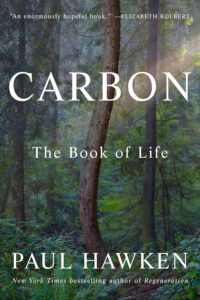
Paul Hawken is one of the most influential environmental activists internationally, as well as an entrepreneur and author. His work combines ecology, economics, and climate action, with an approach focused on systemic and regenerative solutions.
In this book, Paul Hawken proposes a necessary shift in the contemporary climate narrative. Against a reductionist view of carbon as synonymous with a problem, he presents it as the fundamental element of life, tracing a story that connects chemistry, biology, culture, and the evolution of the planet.
Through a multi-voiced, multidisciplinary structure, Carbon invites readers to understand natural cycles from an integrative perspective, moving away from simplified narratives to engage with the complexity of living systems. Rather than offering specific solutions, the book proposes a shift in perspective: understanding that the climate crisis is not only a technical problem, but also a matter of our relationship with the natural world.
5. Going for Zero — Carl Elefante
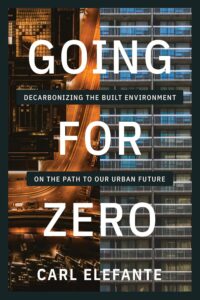
Carl Elefante is an architect and former president of the American Institute of Architects (AIA), recognised for his advocacy of renovation as a key strategy in the face of the climate crisis. His work has been instrumental in spreading the concept that “the greenest building is the one that already exists.”
In his book Going for Zero, Elefante focuses his reflection on one of the construction sector’s major blind spots: the tendency to build new as the default response. Against this inertia, the author puts forward a clear statement that has shaped the contemporary debate on sustainability in architecture: the greenest building is the one that already exists.
Throughout the book, he develops a robust argument in favour of renovation, reuse, and upgrading the existing building stock, not only as technical strategies, but as a way of recognising the accumulated value in existing buildings. Embodied energy, material resources, memory, and culture are part of that capital that is often discarded.
More than a technical matter, Going for Zero proposes a paradigm shift: stop understanding architecture as an exercise in constant replacement and start seeing it through the lens of circularity, as a process of transformation, continuity, and care.
6. Forest First — Kiel Moe
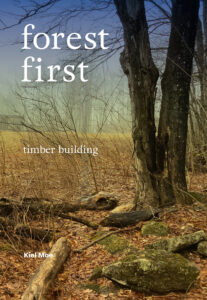
If there is an author who represents a contemporary approach to the relationship between architecture and the environment, it is Kiel Moe.
Moe is an architect, researcher, and professor at MIT, specialising in the relationship between architecture, energy, and materials. His work proposes integrating ecological and productive systems into architectural design, exploring new ways of building based on the logic of resources.
In Forest First, he explores the potential of biomaterials, especially wood, as an alternative to carbon-intensive construction systems. However, the book goes beyond a simple material substitution to propose a profound rethinking of the relationship between architecture, resources, and territory.
Through an approach that connects architecture, forestry, and landscape management, Moe proposes understanding forests not only as natural reserves, but as living infrastructures capable of becoming an active part of the construction process. In this sense, building ceases to be an extractive act and becomes a practice linked to regenerative cycles, where growth, carbon capture, and material production are interconnected.
This approach places materials at the centre of the project, not only for their technical performance, but for their ability to be part of broader ecological systems. Architecture stops working with abstract resources and instead works with living matter, with growth timelines, biological processes, and specific territories.
In a context where decarbonising the sector is urgent, Forest First sets out a clear direction: design not only buildings, but also the material supply chains that make them possible, understanding that every construction decision has a direct impact on the landscape.
Architecture as an agent of transformation
At this point, architecture is presented as a tool capable of responding proactively to the environmental crisis. The books brought together in this block explore how the discipline can evolve towards more regenerative approaches, working in relation to climate, materials, and context. Beyond reducing impacts, the aim is to understand the project as an opportunity to build in harmony with people and the environment, contributing to a deeper transformation of the built environment.
7. Climatic Architecture — Philippe Rahm

Philippe Rahm is a Swiss architect and one of the leading figures in climatic architecture. His research focuses on design based on environmental variables such as temperature, humidity, and radiation, redefining the role of architecture in the context of the energy and climate crisis.
In Climatic Architecture, Rahm proposes a paradigm shift in how architecture is conceived, moving the focus from form to environmental conditions. Rather than designing objects, he proposes designing climates, working with variables such as temperature, humidity, and radiation to create comfort and spatial quality. Architecture is no longer understood as something exclusively visual, but incorporates the invisible—air, heat, and light—as true design materials.
This approach profoundly challenges the architectural tradition based on formal composition, introducing a logic in which energy and physical phenomena become design tools. Architecture thus moves from building forms to building atmospheres, establishing a direct relationship between body, space, and climate.
The book explores concepts such as bioarchitecture, understood as a way of designing that not only reduces environmental impact, but also integrates natural processes as an active part of the design. In this sense, architecture ceases to be an isolated object and becomes a system capable of interacting with its surroundings in a dynamic and regenerative way.
In a context of climate emergency, this approach not only opens up new spatial possibilities, but also proposes a more precise relationship between design, energy consumption, and wellbeing, placing climate as the project’s starting point.