Sustainability

2025 Learning Resource Guide

Collection of reference publications on sustainable architecture
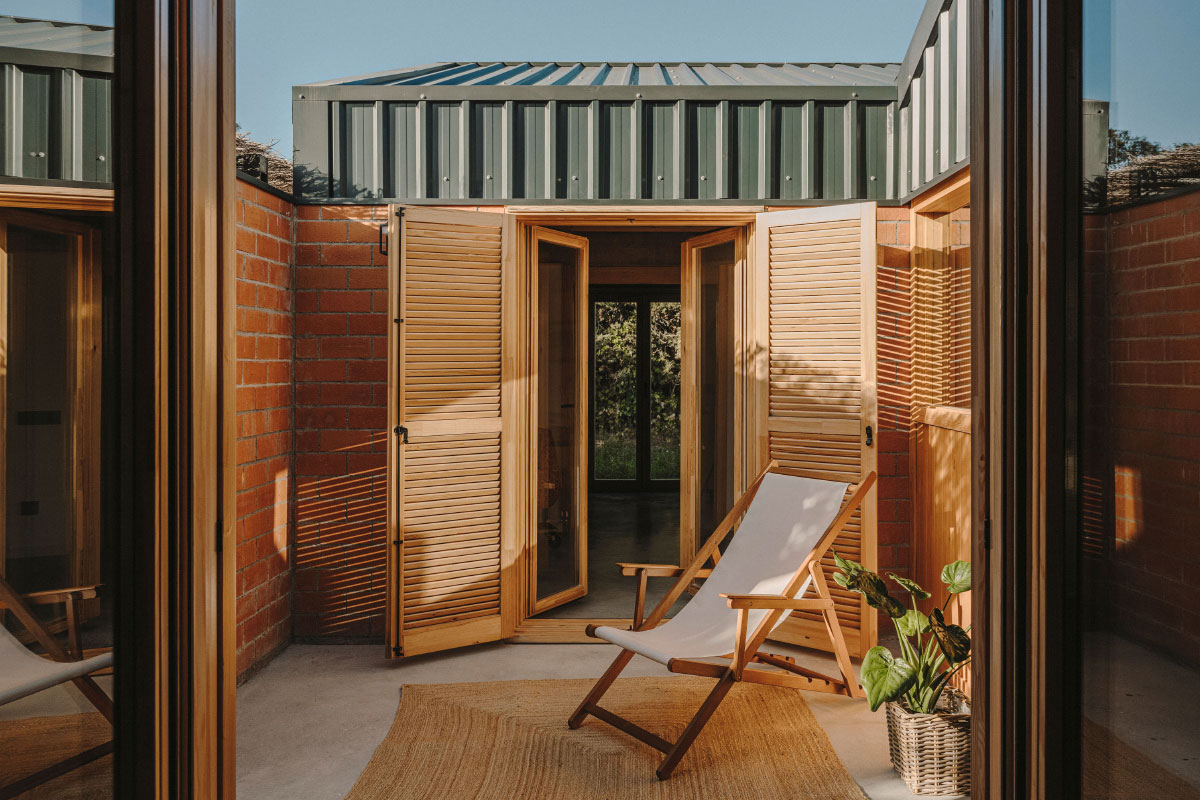
We share our curated selection of key learning resources to explore architecture, health, and climate change in greater depth.
Publicado el 27 May 2024
recursos de aprendizaje

Living in a climate emergency: our generation has had to live through one of the most uncertain eras in human history.

Behind the apparent calm and well-being perceived by the small percentage of fortunate inhabitants of the global north, our planet is undergoing massive changes that are slowly affecting the fragile balance upon which our civilization rests.

Some skeptics of the theory of infinite growth, which keeps most mortals busy consuming products and content, manage to read enough to understand that we are on the edge of an abyss—unprecedented climate change that could lead us to scientifically documented mass extinction scenarios.

Faced with this reality, some of us choose to fight because we believe that if we manage to connect a sufficient number of conscious individuals and join forces, we can motivate change.

A struggle that stems from our passion for architecture; this is why we work tirelessly to demonstrate that it is possible to achieve a conscious architecture of minimal impact that respects the health of people and the environment, built with natural materials of low ecological footprint and local origin, forming part of a closed cycle.

To carry this out successfully, training and learning are essential. For this reason, today we share our list of indispensable learning resources—a list we have compiled over more than 10 years of practice and activism in sustainable architecture, published openly with the aim of reaching more committed people and joining collective efforts.

This is an open list that we will expand as the months and years go by, and we hope to expand it with your contributions as well.

1. Regulations and frameworks


EPBD
 

Directive of the European Parliament and of the Council on the Energy Performance of Buildings, approved on April 24.

The new EPBD establishes stricter standards for energy efficiency in construction; we are moving from building Nearly Zero-Energy Buildings to Zero-Emission Buildings. Most importantly, for the first time, it addresses embodied carbon, making it mandatory to declare the calculation of emissions derived from building materials.

Download link for the latest version of the EPBD.


UNE-EN 15978
 

UNE-EN 15978 is a Spanish standard that establishes calculation methods for assessing the environmental performance of buildings through life cycle analysis. Published in May 2012, it focuses on sustainability in construction, providing guidelines to evaluate the environmental impact of buildings throughout their life cycle.

Link for download, though payment is required.


European Commission Level(s)
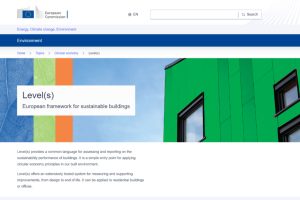
 

The European Commission’s Level(s) framework for sustainable buildings offers a common language to assess and report the sustainability performance of buildings, facilitating the application of circular economy principles in the built environment. It provides a proven system to measure and improve sustainability at all stages, from design to end-of-life, with core indicators covering carbon, materials, water, health, comfort, and climate impacts. Level(s) is a flexible tool for identifying critical sustainability areas and ensuring the future viability of projects or portfolios, contributing to EU policy goals to strengthen the sustainability of European buildings, which represent significant resource consumption and waste generation.

2. SCIENTIFIC ARTICLES


To address the decarbonization of the sector, we must work with verified data. Therefore, architects and builders must work hand-in-hand with engineers and scientists to understand the impact of our constructions and address effective actions.

Below, we have compiled open and free reference scientific articles.


How can carbon be stored in the built environment? A review of potential options
 

How can carbon be stored in the built environment? A review of potential options, Matti Kuittinen, Caya Zernicke, Simon Slabik, Annette Hafner, Architectural Science Review, Special Issue on Low Carbon Buildings and Neighbourhoods, 2021

To achieve carbon neutrality, emissions in the construction sector must be drastically reduced and the remainder offset. Although approaches exist to store carbon in the built environment, they have not been used systematically. This article reviews 13 carbon storage technologies, suggesting underutilized potential for accumulating atmospheric carbon in construction.


Renovation process challenges and barriers: addressing the communication and coordination bottlenecks in the zero-energy building renovation workflow in European residential buildings
 

Renovation process challenges and barriers: addressing the communication and coordination bottlenecks in the zero-energy building renovation workflow in European residential buildings, Alejandro Prieto, Tatiana Armijos-Moya, Thaleia Konstantinou, Architectural Science Review, 2023

To accelerate the implementation of Nearly Zero-Energy Building (NZEB) renovations in Europe, a strategy incorporating both passive and active components is required, which increases complexity and costs. This article proposes mapping the renovation process on digital platforms to address communication and coordination challenges among the various stakeholders involved.


The Role of Green Building Materials in Reducing Environmental and Human Health Impacts
 

The Role of Green Building Materials in Reducing Environmental and Human Health Impacts, Environ Res Public Health, 2020

Conventional building materials (CBMs) are a primary source of indoor air pollutants. Biocomposites, as green building materials (GBMs), are an ecological alternative that significantly reduces these impacts. This study compares hybrid bio-based biocomposites with petroleum-based composites, showing that biocomposites can reduce human health impacts by more than 50%. The results indicate that biocomposites are a sustainable solution for improving air quality and health.


Overview of HOMEChem: House Observations of Microbial and Environmental Chemistry
 

Overview of HOMEChem: House Observations of Microbial and Environmental Chemistry, Environmental Science: Processes & Impacts, 2019

The HOMEChem study analyzes how daily activities affect emissions and chemical transformations in indoor air. Experiments in a research house showed that cooking generates large amounts of VOCs, CO2, NOx, and ultrafine particles. Even without occupancy, organic gas concentrations were higher indoors than outdoors, and organic material accumulated on interior surfaces.


BUILDING AS A GLOBAL CARBON SINK?
 

Building as a Global Carbon Sink? A Reality Check on Feasibility Limits, One Earth, 2020

The built environment is difficult to decarbonize but plays a crucial role in climate change mitigation amid rapid urbanization. Replacing conventional building materials with biological materials that store carbon offers a potential solution. Here, we reflect on the capacity of global forests to provide the necessary land area by mid-century.


CARBON REDUCTION TECHNOLOGY PATHWAYS FOR EXISTING BUILDINGS IN EIGHT CITIES
 

Carbon reduction technology pathways for existing buildings in eight cities, Nature Communications, 2023

We collaborated with urban leaders in eight global cities to develop technological strategies to reduce carbon emissions in existing buildings in the short and long term. Our renovation and local photovoltaic generation approaches can decrease energy use and emissions by up to 66% and 84%, respectively. Cities like Braga, Dublin, Florianópolis, Middlebury, and Singapore are on track to reach their 2030 targets, while Florianópolis and Singapore could achieve 2050 goals with the projected decarbonization of the power grid.


HEALTH EFFECTS OF ARTIFICIAL LIGHT
 

Health Effects of Artificial Lights, Scientific Committee on Emerging and Newly Identified Health Risks (SCENIHR), 2012
Artificial light for general visibility presents a low risk of acute pathological effects due to lower exposure levels than sunlight. No significant risk of retinal damage from blue light in common lamps has been demonstrated, but nighttime exposure could increase risks such as breast cancer and sleep, gastrointestinal, mood, and cardiovascular disorders. Further research is needed to better understand the medical effects of various lighting technologies.


The role of green building materials in reducing environmental and human health impacts


The Role of Green Building Materials in Reducing Environmental and Human Health Impacts, Int J Environ Res Public Health, 2020

The study investigates the impact of conventional building materials (CBMs) versus green building materials (GBMs) such as biocomposites. It focuses on the reduction of indoor and outdoor air pollutants through hybrid biomass-based biocomposites compared to fully petroleum-based composites. Using Life Cycle Assessment (LCA) methods, it concludes that biocomposites could reduce human health impacts by more than 50%, highlighting their potential as an environmentally friendly solution.


SICK BUILDING SYNDROME


Sick building syndrome: risk factors, National Institute for Occupational Safety and Health, 2019

Based on currently available information, there is little doubt that occupants of certain buildings exhibit a higher incidence of illness during work than would logically be expected. Although symptoms are generally mild, they cause discomfort to a large number of people employed in these buildings and, in certain circumstances, can significantly influence absenteeism rates.

3. ESTUDIOS DE REFERENCIA


Beyond Growth, Pathways towards sustainable prosperity in the EU
 

Beyond Growth, Pathways towards sustainable prosperity in the EU, European Parliament, 2023

Estudio de referencia que surge de la conferencia Más allá del Crecimiento organizado por el Parlamento Europeo que tuvo lugar del 15 al 17 de mayo de 2023. Este estudio nos introduce en el debate sobre ir más allá del crecimiento económico. Se divide en dos partes: la primera presenta el estado actual, destacando la dependencia del crecimiento económico y el PIB como medida clave, así como sus puntos ciegos y la necesidad de abordar múltiples fallas del sistema. La segunda parte explora el caso para cambiar los impulsores subyacentes del sistema y cómo puede producirse una transformación del sistema, presentando marcos de políticas existentes o sugeridas para efectuar cambios, así como herramientas específicas relevantes para realizar transiciones económicas.


ipcc sixth assessment report chapter 9: buildings
 

Capítulo 9: Edificios, Climate Change 2022: Mitigation of Climate Change. Contribution of Working Group III to the Sixth Assessment Report of the Intergovernmental Panel on Climate Change, IPCC, 2022

En 2019, el sector de la construcción generó 12 GtCO2-eq en emisiones de GEI, representando el 21% de las emisiones globales, con un 57% proveniente de la generación externa de electricidad y calor, un 24% de emisiones directas de CO2 in situ y un 18% de la producción de cemento y acero. Además, la demanda de energía final en edificios alcanzó los 128,8 EJ, siendo los edificios residenciales responsables del 70% de esta demanda y superando los 43 EJ en consumo de electricidad, lo que representó más del 18% de la demanda global de electricidad.


Embodied Carbon in the Building Sector
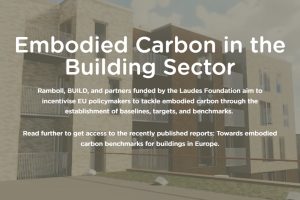
 

Embodied Carbon in the Building Sector, Annex 72 – Assessing Life Cycle Related Environmental Impacts Caused by Buildings, C Ramboll, 2022

Las decisiones de inversión en edificaciones realizadas hoy determinan en gran medida sus impactos ambientales a lo largo de décadas, implicando un equilibrio entre inversiones iniciales y potenciales ahorros a lo largo de su vida útil. La Evaluación del Ciclo de Vida (LCA) complementa la información económica al proporcionar datos sobre los impactos ambientales, lo que ayuda a tomar medidas para aumentar la eficiencia de recursos en la construcción.


AIR QUALITY GUIDELINES FOR EUROPE
 

Air Quality Guidelines Second Edition, World Health Organization, 2000
Las primeras guías de calidad del aire de la OMS para Europa se publicaron en 1987 y han sido actualizadas debido a nuevos datos y avances en la evaluación de riesgos. Estas guías, desarrolladas en colaboración con la IPCS y la Comisión Europea, buscan proteger la salud pública estableciendo niveles de contaminantes seguros. Proveen información y orientación a las autoridades para la toma de decisiones sobre gestión de riesgos.


CALIDAD DEL AMBIENTE INTERIOR EN EDIFICIOS DE USO PÚBLICO


Calidad del Ambiente Interior en Edificios de Uso Público, Comunidad de Madrid, 2018

Hace más de una década, la Dirección General de Salud Pública de la Comunidad de Madrid publicó el Documento Técnico sobre calidad del aire interior en edificios públicos, muy bien recibido por profesionales del sector. La nueva edición, diseñada por la Subdirección General de Sanidad Ambiental, incluye una revisión detallada, nuevas secciones sobre riesgos emergentes y medidas de prevención y control, reflejando avances científicos y cambios regulatorios.


CALIDAD DEL AMBIENTE INTERIOR EN EL TRABAJO


Calidad del Ambiente Interior en el Trabajo, Instituto Nacional de Seguridad y Salud en el Trabajo, 2022

El estudio de soluciones a problemas surgidos desde los años 70, como la crisis del petróleo de 1973 y los intentos de ahorro energético que resultaron en ventilación deficiente y renovación insuficiente del aire interior, originó el campo de la Calidad Ambiental Interior (CAI) o Indoor Environmental Quality (IEQ).


CONTAMINACIÓN DEL AIRE AMBIENTE (EXTERIOR)


Contaminación del Aire Ambiente (Exterior), Organización Mundial de la Salud, 2022

La contaminación del aire es un grave riesgo para la salud, causando 4,2 millones de muertes prematuras anuales, especialmente en países de ingresos bajos y medianos. En 2019, el 99% de la población mundial vivía en áreas que no cumplían con las Directrices de la OMS. Mejorar el transporte, la eficiencia energética y la gestión de residuos, así como usar energía limpia, son medidas clave para reducir la contaminación.


INDOOR AIR POLLUTION


Indoor Air Pollution, An Introduction for Health Professionals, U.S. Environmental Protection Agency, 1997

La contaminación del aire interior plantea desafíos para la salud, especialmente en hogares, escuelas y lugares de trabajo. Este estudio ofrece una guía para profesionales de la salud sobre cómo identificar y abordar problemas de contaminación del aire interior, centrándose en condiciones agudas y proporcionando sugerencias para acciones correctivas. Las personas pasan más del 90% de su tiempo en interiores, donde los contaminantes suelen ser más altos que en el exterior.


CIRCULAR BUSINESS MODELS


Circular Business Models for the Built Environment, ARUP, 2017

Para promover la economía circular, es crucial mejorar la gobernanza, las regulaciones y los modelos de negocio. Los modelos de negocio circulares permiten mantener activos en su máximo valor y promueven el capital natural. Se requieren diferentes modelos para distintas etapas del ciclo de vida de los activos, trabajando de forma independiente o colaborativa. La implementación exitosa depende de la colaboración entre diseñadores, proveedores, prestadores de servicios, contratistas y empresas de reciclaje, compartiendo materiales, energía, información y servicios.


BUILDING MATERIALS and the climate


Building Materials and the Climate: Constructing a New Future, United Nations Environment Programme y Yale Center for Ecosystems + Architecture, 2023

El informe destaca la urgente necesidad de nuevos modelos de cooperación para descarbonizar materiales de construcción y alcanzar metas de emisiones netas cero en el sector para mediados de siglo. Se enfoca en tres vías clave: evitar la extracción y producción de materias primas mediante economía circular, cambiar a prácticas regenerativas con materiales de bajo carbono, y mejorar métodos para descarbonizar materiales convencionales.


A Practical Guide to Climate-resilient Buildings & Communities


A Practical Guide to Climate-resilient Buildings & CommunitiesBuilding Materials and the Climate: Constructing a New Future, United Nations Environment Programme, 2021

Esta guía práctica demuestra cómo se pueden construir edificios y espacios comunitarios para aumentar su resiliencia al cambio climático, especialmente en países en desarrollo donde las estructuras son en gran medida autoconstruidas. La publicación ofrece una visión general de los tipos fundamentales de intervenciones a escala de edificio, incluyendo el uso de soluciones basadas en la naturaleza.


2022 global status report for buildings and construction


2022 Global Status Report for Buildings and Construction, United Nations Environment Programme, 2022

El Informe Global de Estado para Edificaciones y Construcción (Buildings-GSR) es una publicación destacada de la Alianza Global para Edificaciones y Construcción (GlobalABC). Proporciona una instantánea anual del progreso del sector de edificaciones y construcción a escala mundial, evaluando el estado de políticas, financiamiento, tecnologías y soluciones para verificar si el sector está alineado con los objetivos del Acuerdo de París. Además, suministra evidencia a los interesados para persuadir a los responsables políticos y a la comunidad global de edificaciones y construcción a tomar medidas.


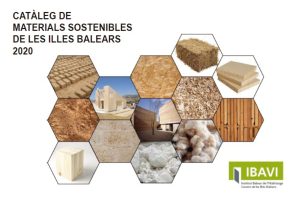
CATÀLEG DE MATERIALS SOSTENIBLES DE LES ILLES BALEARS 2020


Catàleg de Materials Sostenibles de les Illes Balears 2020, Institut Balear de l’Habitatge (IBAVI), 2020

Publicación del IBAVI, que gestiona el parque de vivienda público de las Islas Baleares bajo dos premisas esenciales: afrontar la emergencia habitacional y, a la vez, la emergencia climática. Se trata de un organismo público adscrito a la Consejería de Movilidad y Vivienda del Gobierno de las Islas Baleares, cuyo principal objetivo es la promoción y el alquiler social de vivienda protegida desde 1986.


GUIA TÈCNICA DE BIOHABITABILITAT


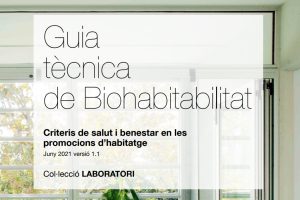
Guia tècnica de Biohabitabilitat, Criteris de salut i benestar en les promocions d’habitatge, INCASÒL, 2021

La guía forma parte de la serie COLECCIÓN LABORATORIO del INCASÒL, ofreciendo documentos técnicos basados en su experiencia. El documento fue elaborado por la Comunidad de Conocimiento de Salud del CEIC-Salut junto a la arquitecta Sonia Hernández-Montaño Bou, especialista en biohabitabilidad y bioconstrucción de Arquitectura Sana.


ZERO CARBON BUILDINGS 2050


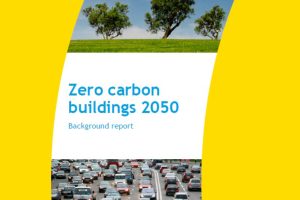
Zero carbon buildings 2050 Background report, CE Delft, 2020

El informe destaca la necesidad urgente de abordar los edificios residenciales para alcanzar las metas de emisiones netas de gases de efecto invernadero (GEI) para 2050. Identifica políticas clave a nivel de la UE, nacional y local, y su potencial para reducir las emisiones de GEI en el entorno construido. Se señala que las emisiones de GEI provienen tanto del uso operativo de energía como de los materiales y procesos constructivos, y bajo las políticas actuales se prevé una reducción del 30% en las emisiones anuales de edificios residenciales para 2050.


technology review of composing toilets


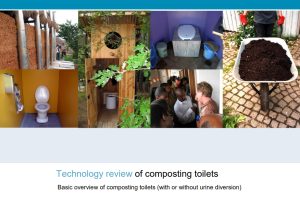
Technology review of composing toilets, Basic overview of composting toilets, Sustainable sanitation ecosan, 2011

Este estudio explica el diseño y uso de inodoros composteros, tanto fabricados como construidos por los propietarios. También aborda brevemente el compostaje externo en unidades separadas de los inodoros, generalmente ubicadas en el jardín. Los inodoros composteros emplean un proceso biológico para descomponer los desechos, con ventilación para mantener condiciones óptimas. Se discute la gestión de leachate y compost, así como los requisitos operativos y mantenimiento necesario para su funcionamiento adecuado.


DETOXING CARPETS


Detoxing Carpets, Pathways towards safe and recyclable carpet in a truly circular economy, Changing Markets Foundation, 2018

Este informe sobre sustancias peligrosas en alfombras vendidas en Europa destaca cómo estos químicos afectan la salud de consumidores y trabajadores, además de obstaculizar la transición hacia una economía circular. Recomienda al sector de alfombras rediseñar productos para eliminar toxinas y mejorar la calidad y seguridad. Se sugiere a los legisladores adoptar normativas específicas y un esquema de Responsabilidad Extendida del Productor para fomentar productos libres de toxinas y reciclables.


CONSUMIENDO QUÍMICA


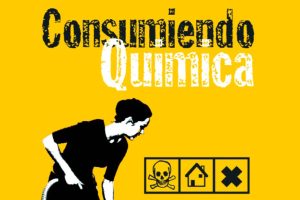
Consumiendo Química, Las sustancias peligrosas en el polvo doméstico como indicador de la exposición química del hogar, Greenpeace, 2003

Sorprende la falta de conciencia general sobre la presencia de sustancias químicas peligrosas en productos de consumo diario, como muebles y aparatos electrónicos, que pueden liberarse en nuestros hogares y contaminar el medio ambiente. Estas sustancias, como ftalatos, retardantes de llama y compuestos organoestánnicos, están presentes en niveles significativos en el polvo doméstico en toda Europa, según estudios recientes. Este informe amplía nuestro entendimiento sobre la contaminación química en el hogar, subrayando la importancia de abordar esta problemática para proteger la salud pública y el medio ambiente.


HOUSING AND HEALTH GUIDELINES


Housing and Health Guidelines, World Health Organization, 2018

Las Directrices de Vivienda y Salud de la OMS ofrecen recomendaciones prácticas basadas en evidencia reciente para mitigar el impacto negativo de viviendas inseguras y de calidad deficiente en la salud. Abordan temas como hacinamiento, temperaturas extremas, riesgos de lesiones en el hogar y accesibilidad para personas con discapacidades. Existe disponible también un summary en castellano.


EDIFICIOS Y SALUD


Edificios y Salud, Reinventar el Hábitat Pensando en la Salud de las Personas, Green Building Council España, 2021

Líderes en el desarrollo del hábitat humano, CGATE, GBCe y AEICE destacan la importancia de diseñar edificios que promuevan la salud y el bienestar en un contexto de transformación y nuevos estilos de vida. A través del Foro Edificios y Salud, más de 60 expertos colaboraron en 2021 para identificar criterios, estrategias y soluciones para edificaciones saludables, enfatizando oportunidades y limitaciones. Este documento resume las conclusiones alcanzadas, reflejando las visiones individuales de los participantes, no necesariamente las de las organizaciones promotoras.


7 LLAVES PARA UN EDIFICIO SALUDABLE


Edificios y Salud, 7 Llaves para un edificio saludable, Consejo General de Colegios de Médicos, Organización Médica Colegial de España y Consejo General de la Arquitectura Técnica de España, 2019

Hasta mediados del siglo XX, la salud se entendía como la ausencia de enfermedad. A partir de entonces, se amplió esta definición para incluir el bienestar físico, mental y social, según la OMS. Esta nueva perspectiva enfatiza un estado completo de salud y no solo la ausencia de enfermedades.


THE 9 FOUNDATIONS OF A HEALTHY BUILDING


The 9 Foundations of a Healthy Building, Clear and actionable core elements of healthy indoor environments, Harvard University, 2017

El concepto de las “9 Fundaciones de un Edificio Saludable” surgió de interacciones con diversos profesionales del sector inmobiliario y académico. Se buscó simplificar la idea de cómo hacer que los edificios sean saludables, identificando algunas bases fundamentales. El enfoque se centra en establecer principios claros para mejorar la salud en entornos construidos.


COMBINED OR MULTIPLE EXPOSURE TO HEALTH STRESSORS


Combined or multiple exposure to health stressors in built environments, World Health Organization, 2013

Millones de personas en la Región Europea de la OMS pasan la mayor parte de su tiempo en interiores, enfrentando riesgos como la contaminación del aire, humedad, y falta de condiciones sanitarias adecuadas. Aunque ha habido mejoras, persisten desafíos significativos relacionados con la calidad de los edificios, afectando desproporcionadamente a grupos vulnerables. Este informe revisa la evidencia sobre múltiples riesgos en ambientes interiores y busca entender mejor sus impactos en la salud pública.


BETTER BUILDING MATERIALS


Better Building Materials, Understanding Human Health and Environmental Atributes, US Green Building Council, 2021

Este texto destaca la importancia crítica de las decisiones sobre materiales de construcción en la salud humana y el medio ambiente a lo largo del ciclo de vida de los productos. Se enfoca en cómo estas decisiones afectan a trabajadores, ocupantes de edificios y recursos naturales, destacando la necesidad de comprender y gestionar los impactos de los materiales de manera integral y sostenible.


10 Whole Life Cycle Recommendations for The Buildings Breakthrough


10 Whole Life Cycle Recommendations for The Buildings Breakthrough, GlobalABC, One Planet Network y Life Cycle Initiative, 2024

Se trata de una lista de recomendaciones basadas en el consenso desarrolladas a través de una amplia participación de las partes interesadas liderada por el Materials Hub, con la ambición de promover el pensamiento político sobre el ciclo de vida completo a nivel mundial y crear conciencia sobre la importancia de abordar las emisiones del ciclo de vida completo en la implementación de los objetivos del avance de los edificios.


NDCs for Buildings: Ambitious, Investable, Actionable, and Inclusive


NDCs for Buildings Ambitious, Investable, Actionable, and Inclusive, GlobalABC y PEEB, 2024

El documento destaca la importancia del sector de la construcción en la acción climática y propone integrar este sector de manera más efectiva en las Contribuciones Determinadas a Nivel Nacional (NDC) mediante medidas que consideren el ciclo de vida completo de los edificios, como la eficiencia energética, el uso de materiales sostenibles y la promoción de energías renovables. Además, subraya la necesidad de que estas medidas sean ambiciosas, viables, inclusivas y atractivas para la inversión, ofreciendo ejemplos prácticos y marcos habilitantes para su implementación. La guía busca transformar el sector hacia un desarrollo sostenible y resiliente, alineado con los objetivos climáticos globales.


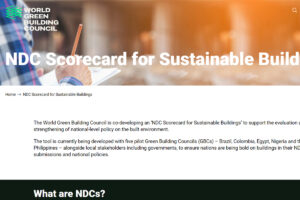
NDC Scorecard for Sustainable Buildings


NDC Scorecard for Sustainable Buildings, World GBC, 2024

El Consejo Mundial de Construcción Sostenible está desarrollando conjuntamente una “Tarjeta de puntuación de las NDC para edificios sostenibles” para apoyar la evaluación y el fortalecimiento de las políticas a nivel nacional sobre el entorno construido. La herramienta se está desarrollando actualmente con cinco Consejos de Construcción Sostenible (GBC) piloto (Brasil, Colombia, Egipto, Nigeria y Filipinas) junto con partes interesadas locales, incluidos los gobiernos, para garantizar que las naciones sean audaces en materia de edificios en sus presentaciones de NDC y políticas nacionales.


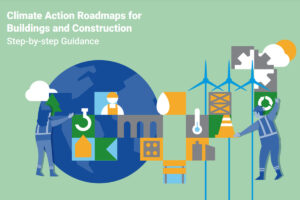
Climate Action Roadmaps Guide


Climate Action Roadmaps for Buildings and Construction, GlobalABC, UNEP, UNOPS, UN-Habitat, 2024

Una herramienta paso a paso para descarbonizar edificios a lo largo de la cadena de valor, con hojas de ruta nacionales para Bangladesh, Ghana y Senegal.


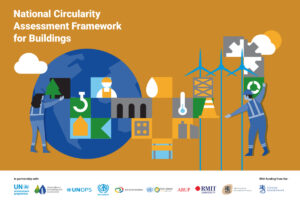
National Circularity Assessment Framework


National Circularity Assessment Framework, UNEP, GlobalABC, OPN, RMIT, UN-Habitat, UNOPS, 2024

Un conjunto de herramientas para evaluar la circularidad en los sectores de la construcción, financiado por Finlandia.


Sufficiency and the Built Environment


Sufficiency and the Built Environment Report, Sufficiency Action Hub, 2024

El Centro de Acción de Suficiencia tiene como objetivo demostrar la necesidad, viabilidad y conveniencia social de las medidas de suficiencia en el sector de la construcción, fomentando una comprensión compartida en todos los niveles de toma de decisiones. Su objetivo es construir una comunidad diversa de partes interesadas en todo el mundo, de varios sectores de la cadena de valor de la construcción, para adaptar las soluciones de suficiencia a diferentes contextos, reconociendo las disparidades entre el Norte y el Sur Global.


Prioritising Existing Buildings


Prioritising Existing Buildings for People and Climate, BPIE, 2024

La suficiencia como estrategia para enfrentar la crisis de la vivienda, lograr los objetivos climáticos y de recursos y revitalizar las comunidades. Un informe centrado en optimizar los edificios existentes para satisfacer las necesidades de espacio y accesibilidad respetando los límites planetarios.


Business Breakthrough Barometer 2024


Business Breakthrough Barometer 2024, WBCSD, 2024

El pulso anual de las empresas líderes sobre la transición a cero emisiones netas. Un análisis de referencia sobre las transiciones hacia emisiones netas cero, que identifica oportunidades de negocio y prioridades gubernamentales en sectores de altas emisiones.


Circular Practices in Buildings and Construction to Achieve the Sustainable Development Goals


Circular Practices in Buildings and Construction to Achieve the Sustainable Development Goals, Usha lyer-Raniga, 2024

Este libro esclarecedor es una respuesta oportuna a tres de las crisis planetarias más importantes que enfrenta la humanidad: el cambio climático, la contaminación y la pérdida de biodiversidad. Usha Lyer-Raniga explora cómo el programa de construcción y edificación sustentables (SBC, por sus siglas en inglés) de One Planet Network ha proporcionado un camino claro y viable para abordar estas cuestiones críticas.

4. NON-SCIENTIFIC REFERENCE ARTICLES


Balancing CO2 emissions in construction


learning resources

Balancing CO2 emissions in construction, The construction sector needs to become aware of the necessary balance of its GHG emissions, EcoHabitar Magazine, 2023

This article underscores the need to balance CO2 emissions in construction, highlighting that a large part of primary energy demand and raw material consumption comes from this sector. Challenges in achieving carbon neutrality are discussed, and strategies for storing and capturing carbon in buildings, such as the use of bio-based materials and carbon capture and storage technologies, are explored.


CARBON-NEGATIVE CONSTRUCTION


Carbon-Negative Construction, Lucy Wang, Anthropocene, 2024

Article on a new generation of building materials aimed at actively removing carbon from the air: hempcrete, engineered living materials, mushroom panels, carbon-negative thermoplastics…

5. TRAINING


Master’s in Bioconstruction


learning resources

Master’s in Bioconstruction, IEB Spanish Institute of Baubiologie

The growing interest in Bioconstruction is reflected in the demand for qualified professionals. The Master’s in Bioconstruction from the Spanish Institute of Baubiologie offers quality training backed by experts in the field. Aimed at students and professionals in construction, architecture, engineering, health, and environmental sciences, the one-year program combines online study with in-person seminars to provide a holistic and multidisciplinary approach centered on health and well-being.


Master’s of Lifelong Learning in Applied Bioconstruction and Eco-architecture


learning resources

Master’s of Lifelong Learning in Applied Bioconstruction and Eco-architecture, University of Girona, UdG Foundation: Innovation and Training, Directed by Gabriel Barbeta Solà

The Master’s in Eco-architecture at the UdG is aimed at technicians and specialists in construction and building, with admission requirements including a degree in architecture, engineering, or relevant work experience. Program objectives include providing knowledge on bioconstruction, sustainability, and material life cycles, as well as developing skills in rehabilitation, bioclimatic analysis, and climate change mitigation strategies. Career opportunities cover sustainable construction, energy efficiency, and climate change adaptation in both the private sector and formal education.


MISMeC ETSAV


Master’s in Sustainable Intervention in the Built Environment (MISMeC), Polytechnic University of Catalonia ETSAV

The MISMeC focuses on disciplines related to the built environment, such as architecture and urban planning, with the goal of guiding professionals and future researchers toward sustainability. Students develop strategies to improve urban habitability, achieve carbon independence, and reduce resource use, addressing real projects in urban contexts and promoting carbon-neutral interventions to combat climate change.


Escola SERT


COAC School of Architecture, Official Association of Architects of Catalonia

Escola SERT offers a wide range of training courses adapted to the educational needs of various professionals in the architecture sector, providing courses, postgraduate programs, and master’s degrees focused on themes aligned with market trends and sector growth, with a special emphasis on the design of healthy and sustainable spaces.

6. REFERENCE INSTITUTES OR RESEARCH CENTERS


Parsons Healthy Materials Lab


learning resources

Healthy Materials Lab is a design research laboratory at Parsons School of Design dedicated to promoting a world where people’s health is at the center of all design decisions. Their commitment includes raising awareness about toxic chemicals in building materials and providing resources for designers and architects to create healthier places for everyone to live.


ITeC, Catalonia Institute of Construction Technology


The ITeC Foundation is a non-profit entity dedicated to the research and development of technological products and services for the construction sector since 1978. Its mission is to improve efficiency in the construction life cycle through the generation and transfer of knowledge, while its vision is to become a global institution supporting the construction sector with a comprehensive focus on sustainability, digitalization, and industrialization.


Build Institute at Aalborg University


The Build Institute at Aalborg University, Department of the Built Environment, researches, consults, and teaches on complex issues in the urban, residential, and construction fields, with the aim of building a better and more sustainable society. They conduct research at national and international levels in close collaboration with companies, organizations, and public institutions in the construction sector, using specialized research groups and state-of-the-art laboratory equipment.


BPIE


BPIE is a leading independent center of expertise on the energy performance of buildings, promoting the transition to climate neutrality in Europe and globally. It is Europe’s main independent think tank on the energy performance of buildings. Its vision is a carbon-neutral built environment, aligned with the ambition of the Paris Agreement and in support of a just and sustainable society.


LIVING FUTURE INSTITUTE


The Living Future Institute is based on the belief that offering a compelling vision of the future is a fundamental requirement for reconciling humanity’s relationship with the natural world. It has developed the Red List, a list of chemicals representing “worst-in-class” substances prevalent in the construction industry that pose serious risks to human health and the environment.

7. INDISPENSABLE WEBSITES


Six Classes from the Green Science Policy Institute


learning resources

The sixclasses website from the Green Science Policy Institute focuses on analyzing and avoiding the use of pollutants, highlighting the “Six Classes” of chemicals of concern present in everyday products that can affect our health. This approach helps to better understand these families of harmful chemicals, their functions, their use, and how to avoid them, thus preventing substitution with similar chemicals that could cause harm.


EU Public Health – Indoor Air Quality


The European Union’s Public Health website offers information on air quality, both indoors and outdoors. It addresses the importance of air pollution, the health risks it presents, and provides guidance on how to determine indoor air quality. It also discusses chemicals and household products that can pollute indoor air and presents an assessment by the European Commission’s Scientific Committee on Health and Environmental Risks (SCHER).


EXERGOECOLOGY


Exergoecology is the application of exergy analysis to evaluate natural flows and resources on Earth. The destruction of natural resources involves the dispersion and destruction of exergy, which exergy analysis can describe accurately. Exergy can be considered as the minimum work necessary to produce a natural resource with a specific composition and concentration from common materials in the Reference Environment. Therefore, quantifying natural capital in terms of exergy is more rigorous, consistent, and complete than using mass or money.


PHAROS HABITABLE FUTURE


Pharos provides resources to assess human and environmental health risks of chemicals and building materials, as well as tools to find safer alternatives. Its goal is to reduce the use of hazardous chemicals and improve the inherent safety of materials and products.

Its Informed Product Guidance project consists of research on the health impacts of chemicals on building occupants, translated into easy-to-understand guidance through a color ranking and classification by building materials.


Circular Buildings Toolkit


The Circular Buildings Toolkit developed by ARUP allows for anticipating the future of projects. Circular economy principles have been translated into a prioritized set of strategies and actions relevant to real estate projects.


BAMB – BUILDINGS AS MATERIAL BANKS


BAMB is creating ways to increase the value of building materials. Buildings designed in a dynamic and flexible manner can be incorporated into a circular economy, where materials in buildings maintain their value. This will lead to waste reduction and the use of fewer virgin resources.


MADASTER


Madaster is a company of Dutch origin that received funding through the EU’s Horizon 2020 framework program and currently operates in the Netherlands, Germany, Belgium, Austria, Norway, Switzerland, and the United Kingdom. Its platform facilitates the circular construction and management of real estate and infrastructure in various ways. Important elements include providing information on the materials and products used, the CO2 stored in them, and the possibilities for dismantling them for reuse.


MATERIALS PALETTE


Developed by Architecture 2030, with the support of members of the Embodied Carbon Network (ECN), Materials Palette provides design guidance and attribute-based material specification to immediately and significantly reduce embodied carbon in the built environment on a global scale.


MATERIAL PYRAMID


Material Pyramid is a new online tool that offers an overview of the CO2 impact of materials in construction projects. CINARK at the Royal Danish Academy, School of Architecture, and Vandkunsten developed the interactive version of the Construction Material Pyramid.


GERNOT MINKE


Gernot Minke is an architecture studio based on an architect and academic from the University of Kassel, Germany, specializing in ecological and sustainable construction. Their website features more than 50 research and development projects and influential books such as “Building with Earth” and “Building with Straw Bales.”


IEA EBC


IEA EBC Annex 72 – Assessing Life Cycle Related Environmental Impacts Caused by Buildings, a program that fosters energy research and innovation in the building and community sectors through collaborative R&D projects among 26 member countries. Additionally, it provides detailed scientific reports and informative summaries aimed at policymakers to support informed decision-making.


OPALIS


At the European level, Opalis is a database founded by Rotor, a Belgian association that conducts research on the reuse of construction elements. Its website offers an overview of professional retailers selling building materials from dismantled buildings. The site provides access to information on materials, a map of distributors in Belgium, France, Luxembourg, and the Netherlands, and relevant technical documentation.

8. AWARDS


Catalonia Bioconstruction Awards


learning resources

The Catalonia Bioconstruction Awards, promoted by the Catalonia Bioconstruction Guild, Firhàbitat, and the Bages-Berguedà Technical Inter-college, seek to highlight innovative solutions that prioritize sustainability in construction, promoting energy efficiency and environmental care. With the aim of encouraging innovation and awareness of the importance of bioconstruction, these awards recognize projects that integrate healthy environments, minimize environmental impact, and foster community participation.


Materia Award


The MATERIA award, a continuation of the TERRA, FIBRA, and TERRAFIBRA awards, highlights eco-responsible architectural practices that value local resources such as earth, stone, and plant fibers. These materials promote environmental sustainability, boost the local economy, and create jobs, while highlighting rehabilitation projects that encourage recycling and material diversity in contemporary architecture.


Terra Ibérica Awards


The Terra Ibérica Architecture Award, organized by the College of Architects of León and the Provincial Council of Palencia, seeks to recognize the quality of projects, works, or essays that highlight the use of raw earth as a distinctive element. Projects located in the Iberian Peninsula can participate, distributed in categories such as Housing, Buildings for other uses, and Innovation/Dissemination. The award promotes the valuation of architecture that uses raw earth, fostering innovation and dissemination in this field within the Iberian context.


Aga Khan Award


The Aga Khan Award for Architecture is given every three years to projects that set new standards of excellence in architecture, planning, historic preservation, and landscape architecture. It seeks to identify and encourage building concepts that successfully address the needs and aspirations of societies in which Muslims have a significant presence. 128 awards have been given since 1977, highlighting projects that use local resources and appropriate technology in an innovative way.

9. ASSOCIATIONS WORKING FOR SUSTAINABLE ARCHITECTURE


ACAN UK


ACAN is a network of individuals within architecture and related built environment professions taking action to address the twin crises of climate change and ecological collapse.


AuS – Architecture and Sustainability


learning resources

AUS Arquitectes promotes sustainable habitats for the well-being of the planet and its inhabitants, advocating for the fight against climate change, energy efficiency, and the preservation of natural heritage. Its mission includes promoting best practices within the profession, demanding coherent legal frameworks, and raising social awareness.

With a vision of a more sustainable world, AUS seeks to develop a model of architecture and urban planning independent of carbon, promote resource efficiency, and value local identity to preserve historical heritage. Its board of directors, with a cross-generational vision, drives architectural decarbonization and intergenerational collaboration.


Bioconstruction Guild


learning resources

The Catalonia Bioconstruction Guild was created to join forces and promote the sector from a perspective of health, ecology, circularity, and decarbonization. Its objectives include promoting healthy living environments, serving as a meeting point and support for professionals and entities in the sector, and advocating for the guild’s interests before the administration. It also seeks to address training gaps, establish synergies between sector agents, enhance research into new materials and construction systems, and promote the concept of health linked to construction through multidisciplinary working groups.


GLOBAL ABC


Global ABC is the leading global platform for governments, the private sector, civil society, research, and intergovernmental organizations committed to a common vision: a zero-emission, efficient, and resilient buildings and construction sector.


WORLD GBC


The Green Building Council (WorldGBC) drives the adoption of sustainable and decarbonized built environments globally. It collaborates with companies, organizations, and governments to meet the Paris Agreement and the UN Sustainable Development Goals. It promotes systems change, challenges traditional practices, and fosters best practices to achieve decarbonization and sustainability goals by 2030. In Spain, there is GBC Spain.


ASPB


The Alliance for Sustainable Building Products (ASBP) is a non-profit, mission-led organization with a steadily growing membership of innovative companies and institutions from the built environment sector.

10. VIDEOS


YOUTUBE CHANNEL UNESCO Chair in Earthen Architecture, Constructive Cultures and Sustainable Development


The UNESCO Chair in Earthen Architecture, Constructive Cultures and Sustainable Development promotes the conservation and dissemination of architectural heritage built with earth. Through its YouTube channel, it shares lectures and activities that foster knowledge and research in traditional and sustainable construction techniques. This initiative seeks to integrate teaching, research, and training, relying on active learning methodologies and international cooperation to contribute to sustainable development and the valuation of constructive cultures.


Thanatia: The Earth’s Mineral Limits


Conversation Series, Thanatia. The planet’s mineral limits, Antonio and Alicia Valero

In the fifth meeting of the Conversation Series, with the support of the Club of Rome Spanish Chapter, Antonio and Alicia Valero presented their book Thanatia. The planet’s mineral limits, which addresses the need for a material transition to restore Nature and efficiently reuse resources. “Thanatia” highlights the excessive extraction of mineral resources and the lack of reuse, showing a future where the planet reaches its limits. It describes a world saturated with technological waste that pollutes and degrades ecosystems, affecting entire communities.


The Recivilization


Lecture, The Recivilization, Fernando Valladares

Fernando Valladares offers a lecture on his book The Recivilization at the Popular University of Albacete, addressing topics such as human identity, our majority water content, entrepreneurship, social organization, transcendence toward the common good, the solidarity code on the path, and the final goal: heaven.


A life dedicated to Urban Planning


Lecture, A life dedicated to Urban Planning, Architects, not Architecture, Jan Gehl

Jan Gehl (Denmark, 1936), architect, professor, and urban design consultant, has focused his career on improving the quality of urban life, reorienting city design toward the people of the cities: public life, pedestrians, and cyclists.


What the Fossil Fuel Industry Doesn’t Want You To Know


Lecture, What the Fossil Fuel Industry Doesn’t Want You To Know, TED Talk, Al Gore

In a passionate talk, Nobel laureate Al Gore analyzes the two main obstacles to climate solutions and gives his opinion on how we could solve the environmental crisis in time. You won’t want to miss his harsh criticism of fossil fuel companies for backtracking on their climate commitments, and his call for a global rethink of the role of polluting industries in politics and finance.


WITHOUT ENERGY


Lecture, ETSAV Vallès Inaugural Session, Antonio Turiel

Inaugural session of the 2023-2024 academic year at the ETSAV Vallès School of Architecture by Antonio Turiel, a scientist and communicator with a degree in Physics and Mathematics and a PhD in Theoretical Physics from the Autonomous University of Madrid, who works as a Scientific Researcher at the CSIC Institute of Marine Sciences.


Keys to a sustainable energy transition


Lecture, Keys to a sustainable energy transition, Antonio Turiel

How to abandon fossil fuels without falling into collapse? Is an energy transition possible beyond renewable sources? Why are photovoltaic panels, the electric car, and green hydrogen not the solution to the energy problem? In this video, scientist Antonio Turiel explains the limits and possible solutions to the energy challenges of the future.


Hemp with The Architectural League of New York


Lecture, Hemp with The Architectural League of New York, Healthy Materials Lab

What if local regenerative agriculture were connected to building healthier homes? Building products made from industrial hemp, lime, and water offer a range of valuable features, including energy efficiency, fire resistance, mould resistance, lightness, and regulation of indoor climate and humidity.

Healthy Materials Lab is a design research lab at Parsons School of Design dedicated to improving the health of those most affected by toxic chemicals in building products by creating healthier, more affordable housing through research, education, and advocacy.

11. BOOKS


1) 2050. Why a World Without Emissions Is Almost Impossible – Vaclav Smil (2023)
Vaclav Smil, one of Bill Gates’ favourite authors, offers a rigorous analysis of the enormous technical, economic, and social challenges we face in achieving an emissions-free future.

2) Together – Richard Sennett (2021)
Richard Sennett explores how cooperation, sociability, and public spaces shape our human relationships and community life.

3) Terra Fibra Architectures – Pavillon Arsenal (2021)
An in-depth reflection on the use of natural materials such as earth and plant fibres in contemporary architecture and their transformative potential.

4) Hungry Cities – Carolyn Steel (2009)
Carolyn Steel analyses the connection between urban design and food, and proposes new ways to build cities that are more sustainable and more aware of the food system.

5) PLUS – Lacaton & Vassal (2020)
An innovative approach to socially responsible architecture, focused on refurbishing existing spaces and access to affordable, dignified housing.

6) Regeneration – Paul Hawken (2021)
A practical guide with concrete, collective solutions to address the climate crisis on multiple fronts, grounded in regeneration as a guiding principle.

7) The No-Water Garden – Olivier Filippi (2020)
An essential guide to designing drought-resistant gardens that foster biodiversity and promote environmental sustainability.

8) Design with Life: Biotech Architecture and Resilient Cities – Mitchell Joachim, Maria Aiolova, Terreform One (2022)
A journey through the possibilities offered by biotechnology applied to architecture to build cities that are resilient to the effects of climate change.

9) The 15-Minute City – Carlos Moreno (2021)
An urban proposal in which all essential services are within a 15-minute walk or bike ride, fostering a healthier and more equitable lifestyle.

10) Living in Community – Lacol and La Ciutat Invisible (2023)
A reflection on cooperative housing as a collective, sustainable alternative, removed from real-estate speculation.


1) Stolen Focus – Johann Hari (2022)
Teenagers can only focus on a task for 65 seconds, and adults barely last 3 minutes. Johann Hari argues that we have lost our species’ superpower—and it is not only the phone’s fault.

2) Recivilisation – Fernando Valladares (2023)
The first book by one of our key references, a leading science communicator and climate activist at @la_salud_de_la_humanidad.

3) Without Energy – Antonio Turiel (2022)
The CSIC scientist and researcher analyses the interconnection between global problems, from the pandemic and resource scarcity to the energy crisis.

4) The First Thousand Days – Elisabet Silvestre and Elena Codina (2024)
The environmental health experts address health during pregnancy and the first two years of life.

5) Design for Resilience – Stuart Walker (2023)
Published by MIT, this book is conceived as a guide to resilience, through the creation of restorative designs to mitigate climate change.

6) Towards net zero carbon buildings – SuReal (2022)
SuReal is the company of the future—the consultancy that every architecture practice will rely on in a few years to tackle decarbonisation.

7) How the World Works – Vaclav Smil (2023)
Bill Gates’ favourite author seeks to explain a complex, interconnected planet where the dispersion of knowledge and the volatility of information prevail.

8) Humanising the Urban Environment – Jan Gehl (2004)
The seminal work by the Danish architect who has focused his career on designing human-centred cities.

9) Manual of Urban Ecology – Audrey Muratet & François Chiron (2021)
Residents of the planet’s most densely populated cities live in a state of extreme ecological poverty.

10) Regeneration: Ending the climate crisis in one generation –Paul Hawken (2021)
The regeneration movement is spreading rapidly around the world as a solution to climate change across multiple fields.


1) Material Health – Healty Materials Lab (2023)
This pioneering organisation in materials-toxicity outreach brings together expert perspectives for designing healthy spaces.

2) The Home Office – Elisabet Silvestre (2022)
One of the leading communicators on the health of inhabited spaces shares the keys to creating creative, healthy work environments.

3) The Climate Book – Greta Thunberg (2022)
Activist Greta Thunberg compiles essential essays by some of the world’s leading climate activists and scientists.

4) El Croquis – IBAVI (2023)
An El Croquis monograph on the Balearic Housing Institute (IBAVI), which manages public housing development and addresses the housing and climate emergency.

5) Upscaling Earth (2019)
Martin Rauch, an international expert in prefabricated rammed earth, explores—together with architect Anna Heringer and urbanist Lindsay Howe—the potential of earth as a substitute for concrete.

6) Thanatia. The Planet’s Mineral Limits – Antonio and Alicia Valero (2021)
The work of these thermodynamics engineers is essential to understanding the planet’s limits and the risks of consuming resources excessively.

7) Earth for All. A survival guide for Humanity (2022)
This book sets out what the systems change that would enable humanity to design a liveable future on a finite planet truly means.

8) Break Free from Toxins – Nicolás Olea (2019)
After years of research in environment and health, Dr Olea has created a guide to avoiding everyday exposure to toxins.

9) Reimagining sustainable cities – Stephen Wheeler and Christina Rosan (2021)
From an ecological and social perspective, this book identifies the urban design actions needed to improve the quality of life and health of our cities.

10) Less is More – Jason Hickel (2020)
Dr Jason Hickel proposes degrowth and reconnecting with the natural world as a solution to the climate crisis.


1) Your Healthy Home – Elisabet Silvestre (2021)
One of the country’s leading experts in healthy building biology brings together in this book the keys to making a conscious change in our home.

2) The new climate war – Michael E. Mann (2021)
The renowned climate scientist shows how fossil fuel companies divert action on climate change and proposes a plan to save the planet.

3) Biophilia – Eduard O. Wilson (2021)
The most influential biologist of our time speaks of “the innate tendency to focus on life and lifelike processes”.

4) The Uninhabitable Earth – David Wallace-Wells (2019)
“Those of us who live in a skyscraper in New York will die too.” Wells is one of The New York Times’ leading climate change journalists.

5) Designing Regenerative Cultures – Daniel Christian Wahl (2021)
Wahl proposes a “Whole Earth Catalogue”, exploring ways to rethink the crises we face.

6) Comment habiter la terre. Yona Friedman (2016)
A book to reconsider humanity’s place in the Earth’s ecosystem and to think about survival solutions for continuing to inhabit the planet.

7) From Passive House to the Passivhaus Standard (2014)
A practical explanation of the concept of passive architecture, the Passivhaus standard, and its application in warm-climate regions.

8) How to Avoid a Climate Disaster – Bill Gates (2021)
Gates analyses where the total 50 billion tonnes of CO2 that humans emit each year comes from and proposes a plan to bring emissions down to zero.

9) On Fire – Naomi Klein (2021)
If Gates proposes technology as the solution, Klein represents the radically opposite view, challenging companies and governments and calling into question the entire system we have created.

10) Flourish – Martin E.P. Seligman (2012)
The renowned doctor of psychology publishes the conclusions he has drawn after 15 years of studies on the five pillars of positive psychology.