Slow Studio, the promoting group of the 3rd Decarbonisation Conference
On 29 October, the third edition of Decarbonising Architecture took place—an event promoted by the Col·legi d’Arquitectes de Catalunya (COAC) together with the Spanish Council of Architects’ Associations (CSCAE) and the Architects’ Council of Europe (ACE-CAE). This annual event focuses on the challenges and opportunities of decarbonisation in the field of architecture, with the aim of moving towards sustainable, carbon-neutral buildings by 2050.
Slow Studio is the driving group behind the conference and, in addition, through the Arquitectura i Sostenibilitat (AuS) association—of which we are part and where we serve on the board—we have been coordinating the conference and are part of the organising group.
The conference was very well received, with more than 400 attendees. The session, hosted by Francesc Mauri, a geographer and meteorology expert, featured national and international experts in architecture and sustainability, who addressed key topics such as the Energy Performance of Buildings Directive (EPBD) and the New European Bauhaus initiative—both essential to transforming architecture in Europe.
In the morning, the latest implementation updates to the Spanish Building Technical Code (CTE) were presented, along with a session on refurbishment and another dedicated to new-build projects.
Among the most notable sessions was the presentation “The instruments of change: Global Warming Potential, the Renovation Passport and the National Renovation Plan”, delivered by María Teresa Verdú, Director General for Urban Agenda and Architecture at the Ministry of Housing and Urban Agenda (MIVAU). Verdú outlined the upcoming amendment to the CTE through a new Basic Sustainability Document, to be implemented in two phases. The first phase will introduce new design requirements to reduce buildings’ global warming potential, while the second phase will establish the Renovation Passport, a key tool to promote sustainable refurbishment of buildings across Spain.
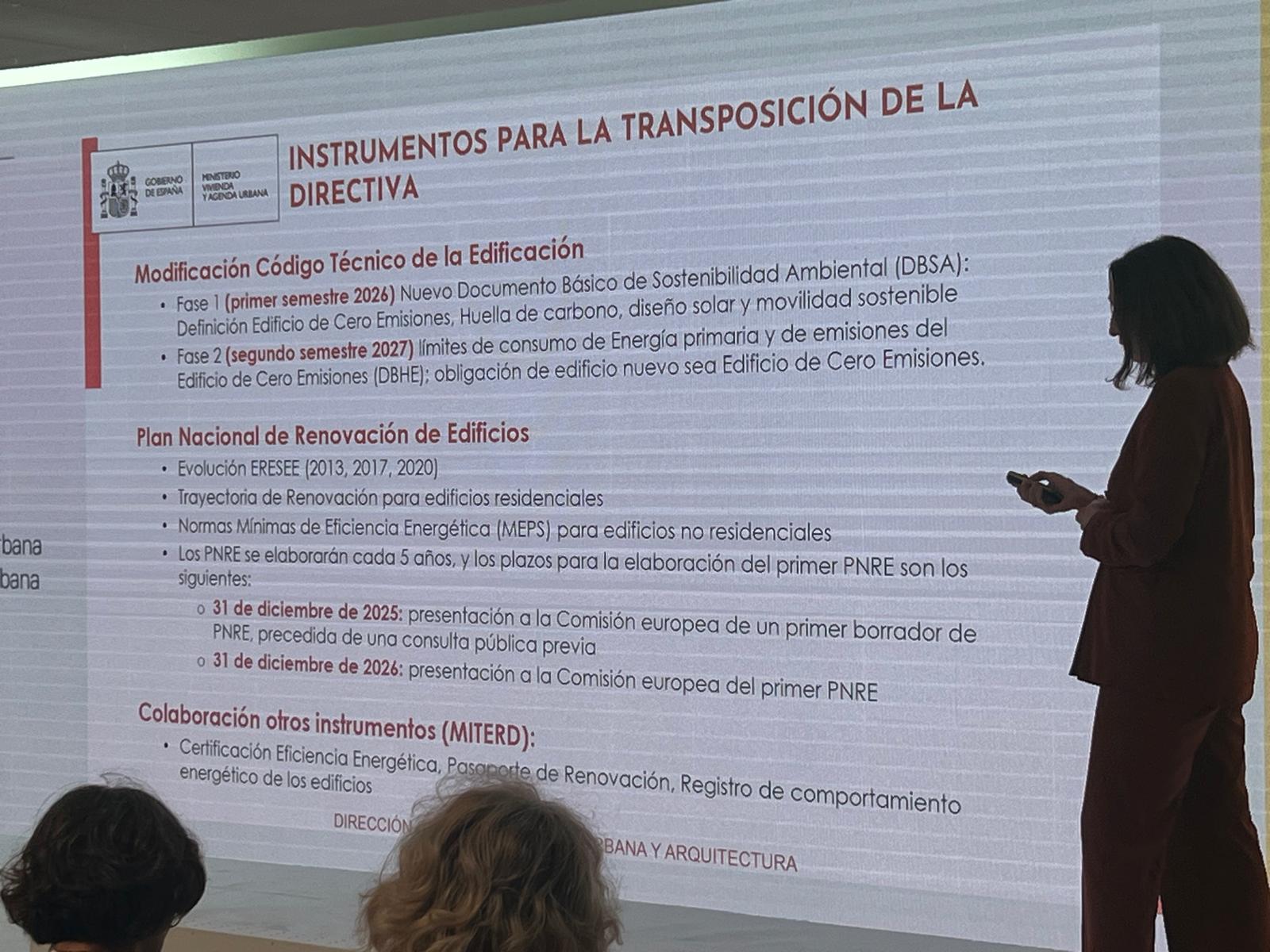
INSTRUMENTS FOR THE TRANSPOSITION OF THE DIRECTIVE
Amendment to the Spanish Building Technical Code
- Phase 1 (first half of 2026) New Basic Environmental Sustainability Document (DBSA): Definition of a Zero-Emission Building, carbon footprint, solar design and sustainable mobility.
- Phase 2 (second half of 2027) Limits on primary energy consumption and emissions for the Zero-Emission Building (DBHE); requirement that every new building be a Zero-Emission Building.
National Building Renovation Plan
- ERESEE evolution (2013, 2017, 2020).
- Renovation pathway for residential buildings.
- Minimum Energy Performance Standards (MEPS) for non-residential buildings.
- The NBRPs will be prepared every 5 years, and the deadlines for preparing the first NBRP are as follows:
- 31 December 2025: submission to the European Commission of a first draft NBRP, preceded by a prior public consultation.
- 31 December 2026: submission to the European Commission of the first NBRP.
Collaboration with other instruments (MITERD)
- Energy Performance Certification, Building Energy Renovation Plan, Performance register.
In a few days, we will share the link to the full video of the event!